430,000 mph: Why Alpha Centauri Still Takes 6,300 Years
Even at 430,000 mph, Alpha Centauri is 6,300 years away. Uncover the monumental obstacles to far future space travel.
The Long Road to the Stars
A journey to the stars would take an immense amount of time. For example, reaching Alpha Centauri, our nearest star system 4.37 light-years away, would take 6,300 years. This is true even with NASA’s Parker Solar Probe, our fastest spacecraft, traveling at 430,000 mph. At light speed, the trip still takes over four years. This distance presents a nearly impossible obstacle. Scientists and engineers are working to reduce these travel times. They aim for trips measured in decades, not millennia.
Distance and Speed Limits
Interstellar travel requires much faster speeds than we currently have. Our solar system’s major planets span about two light-hours. The Sun’s heliosphere extends 120 astronomical units, or 16 light-hours, from Earth. Beyond this boundary lies true interstellar space.
Chemical rockets burn fuel to expel hot gas. This method works for Earth orbit and missions within our solar system. The Mars Perseverance rover, for instance, took seven months to reach Mars. However, chemical fuels lack the energy needed for trips to other stars.
Physicist Robert Zubrin, president of Pioneer Astronautics, highlights this energy challenge. He states that even Mars trips require vast amounts of fuel. Interstellar journeys need propellants capable of pushing a craft to a significant fraction of light speed. Achieving such speeds demands entirely new propulsion physics.
Nuclear Power: The Next Step
Nuclear power offers a large increase in potential energy. The British Interplanetary Society (BIS) explored this in the 1970s. Their Project Daedalus was a concept to reach Barnard’s Star, 5.9 light-years away. Daedalus suggested a two-stage fusion rocket. It would operate on deuterium-helium-3 pellets.
The Daedalus team calculated a 50-year trip. This included four years of acceleration. The craft would reach 12% of light speed, with its engine firing 250 pellets every second.
The Icarus Interstellar project began in 2009. This international team builds on the Daedalus research. They aim to design a functional interstellar probe. Their goal is a trip of 100 years or less to a nearby star. Icarus focuses on robust fusion propulsion systems.
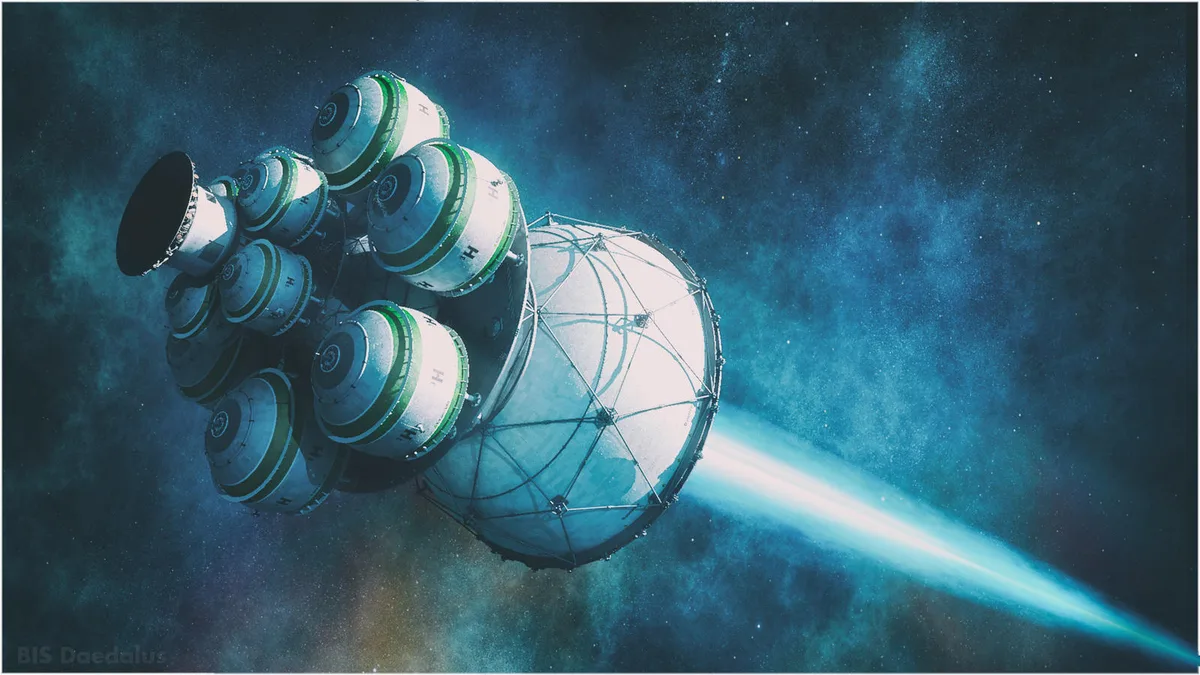
The British Interplanetary Society's Project Daedalus, designed in the 1970s, was a groundbreaking engineering study for an unmanned interstellar probe. This conceptual fusion rocket aimed to reach Barnard's Star within 50 years, inspiring future designs like the Icarus Interstellar project. (Source: deviantart.com)
NASA has also studied nuclear thermal propulsion (NTP) for Mars missions. An NTP engine uses a nuclear reactor to heat liquid hydrogen. It then expels the superheated gas for thrust. NTP could reduce Mars travel times by 25%. Still, these systems are not powerful enough for interstellar journeys.
Lightsails and Warp Drives: Beyond Current Physics
Light itself can propel a spacecraft. Lightsails use the pressure from photons to accelerate. This idea gained attention with the Breakthrough Starshot initiative. Starshot, announced in 2016, plans to send tiny probes to Alpha Centauri.
Billionaire Yuri Milner started Starshot. Stephen Hawking and Mark Zuckerberg served on its board. The plan involves “nanocraft” weighing only a few grams. A powerful ground-based laser array would push these sails. It would accelerate them to 20% of light speed.
At 20% light speed, the Alpha Centauri trip would take about 20 years. Pete Worden, executive director of Breakthrough Starshot, believes this is achievable within a generation. The project faces engineering obstacles. These include building the laser array and ensuring the sail’s durability. The nanocraft would send images and data back to Earth. That transmission alone would add another 4.37 years.
The warp drive concept is far more theoretical. Theoretical physicist Miguel Alcubierre proposed a warp drive metric in 1994. This metric describes how a spacecraft might travel faster than light. It would do so by bending spacetime around itself. The craft would remain stationary inside a “warp bubble.”
Harold “Sonny” White, formerly with NASA Eagleworks, researched warp field mechanics. His team examined the energy requirements for such a drive. The Alcubierre drive would need vast amounts of exotic matter. This matter has negative energy density. Scientists have not yet found such matter.
Human Challenges in Space
Interstellar travel presents huge challenges beyond just propulsion. A journey lasting decades or centuries impacts human bodies and minds. Long-term space radiation risks severe health problems. NASA research shows astronauts lose bone density and muscle mass. These issues worsen on extended missions.
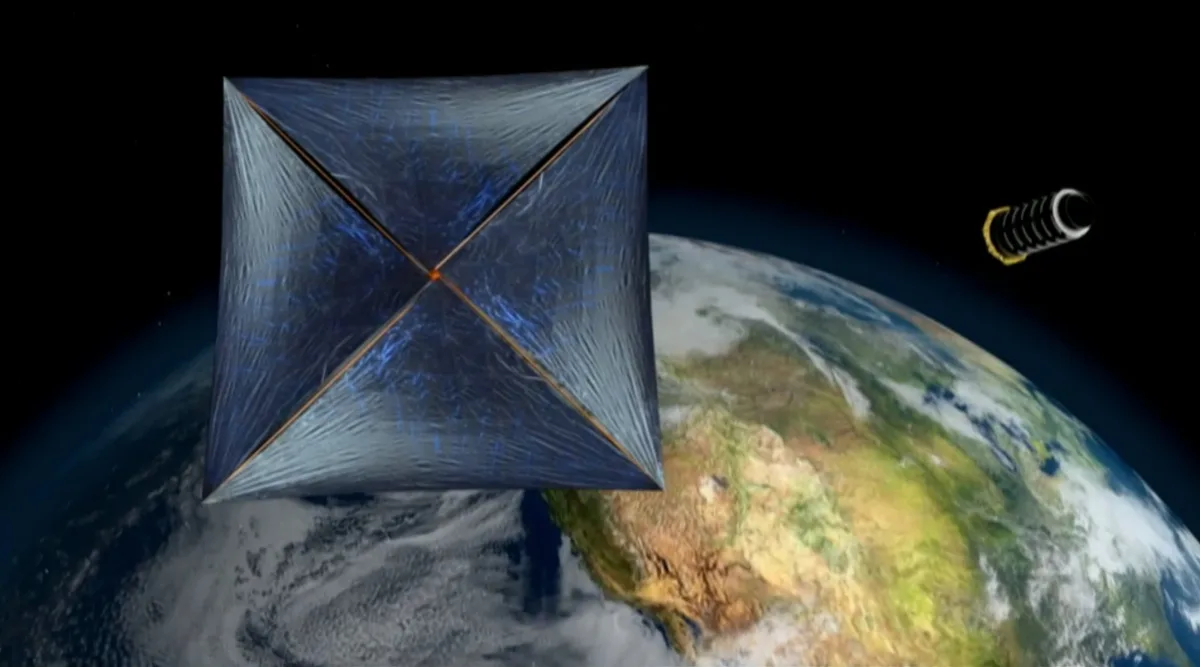
The Breakthrough Starshot initiative plans to send gram-scale 'nanocraft' probes to Alpha Centauri, propelled by powerful ground-based lasers to 20% of light speed, aiming to reach the star system in about 20 years. (Source: space.com)
Generation ships might carry entire populations. These vessels would support life for many generations. People would be born and die on the ship, never seeing Earth, before the journey’s end. Such a mission requires self-sustaining ecosystems. It also needs stable social structures to last for centuries.
The sheer size of space also means communication delays. A signal from Alpha Centauri takes over four years to reach Earth. Real-time conversations become impossible. Scientists at the SETI Institute study these communication problems. They also research how isolation affects long-term crews.
Cosmic dust and micrometeoroids pose another threat. Even tiny particles can cause significant damage at near-light speeds. Strong shielding systems are essential for protecting the crew and equipment. The energy needed to speed up and slow down massive starships remains enormous.
The Future of Exploration
Future space travel will change humanity’s place in the cosmos. Scientists continue to work on improved propulsion ideas. Research into fusion power and exotic matter is ongoing. These efforts push the boundaries of our understanding of physics.
The idea of reaching other stars inspires new concepts in many fields. Materials science, AI, and life support systems all benefit. Every technical problem we solve increases our capabilities. This continuous drive to explore advances scientific discovery on Earth.
Future engineers and physicists will build upon today’s theories. They will create the technology needed for star voyages. The true goal is not just to travel, but to understand. We seek to comprehend our universe and the possibility of life beyond Earth.
FAQ
Q1: How long would it take to reach the nearest star with current technology? A1: Reaching Alpha Centauri, which is 4.37 light-years away, would take approximately 6,300 years using our fastest current spacecraft. This long travel time makes such a journey impractical for humans.
Q2: Are warp drives real? A2: Warp drives are currently theoretical concepts. They are based on Einstein’s general relativity and describe how spacetime might be distorted for faster-than-light travel. No known method exists to create or maintain the exotic matter required.
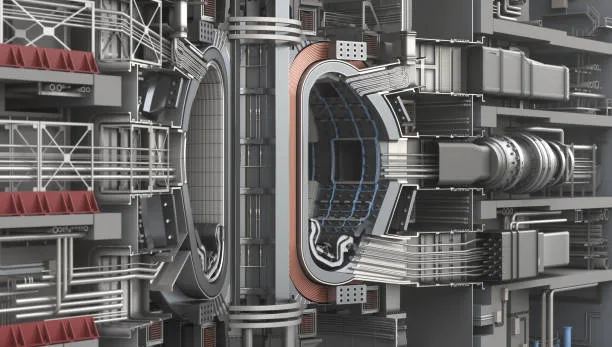
The ITER (International Thermonuclear Experimental Reactor) in France is the world's largest experimental tokamak nuclear fusion reactor, designed to prove the feasibility of fusion as a large-scale, carbon-free energy source. Its success could pave the way for the immense power needed to propel future starships across vast cosmic distances, addressing a key challenge in far-future space travel. (Source: istockphoto.com)
Q3: What are generation ships? A3: Generation ships are hypothetical spacecraft. They are designed for interstellar travel lasting centuries or millennia. Multiple generations of humans would live, reproduce, and die aboard the ship before it reaches its destination.
Q4: What is the biggest hurdle for interstellar travel? A4: The biggest hurdle is the immense energy needed to accelerate a spacecraft to a significant fraction of light speed. Other major challenges include shielding against radiation and micrometeoroids over vast distances and durations.
Micrometeoroid impacts are a constant threat to spacecraft, with even tiny particles traveling at extreme velocities capable of causing significant damage to hulls, solar panels, and instruments. The International Space Station (ISS) frequently experiences such impacts, necessitating advanced shielding and continuous monitoring. (Source: livescience.com)
You might also like:
👉 The $546 Billion Space Race: Private Money, Global Rivalries
👉 Unexplained Mysteries of Science: Cosmos, Quantum & Beyond