
The $141 Billion AI Bet: Are We Headed for a Bust?
AI investments soared to $141 billion in 2023, fueling fears of an unsustainable bubble. Learn why analysts warn of a potential market correction.
Money is pouring into AI. In 2023, investments hit an estimated $141 billion worldwide. That’s a huge jump from previous years. This surge raises a big question: Are we seeing an AI investment bubble? It feels like past market frenzies. Investors are pouring money into AI companies. They especially like generative AI models and the infrastructure that supports them. This fast cash pushes company valuations to record-breaking levels across tech. Financial analysts warn this growth isn’t sustainable.
Today’s AI money flood
Global venture capital funding for AI companies topped $50 billion in just the first half of 2023, PitchBook data shows. That’s a strong appetite for AI innovation. It happened even as other tech investments slowed down. Companies like OpenAI, Anthropic, and Cohere have pulled in billions. They focus on large language models (LLMs) and foundational AI tech. Microsoft put over $10 billion into OpenAI. This shows how committed major tech companies are.
Hardware makers also see huge demand. Nvidia makes AI graphics processing units (GPUs). Its market value went over $2 trillion in early 2024. CEO Jensen Huang reported record earnings. The intense need for AI computing power drove these numbers. This demand for special chips supports much of today’s AI infrastructure. VC firms, hedge funds, and corporate investors are all active here.
This investment wave hits Silicon Valley hard. It also impacts global tech hubs like London and Beijing. Startups promise to change everything, from healthcare to finance. Many new companies don’t have steady revenue. They also lack clear ways to make a profit. Their value often depends on future growth and how much they might change industries. This speculation makes people compare it to past market bubbles.
Echoes of the past: warning signs
Economists see similarities between today’s AI frenzy and the late 1990s dot-com bubble. Back then, internet companies got huge valuations with little to no revenue. Professor Robert Shiller, a Nobel laureate economist at Yale, pointed out these similarities recently. He noted the speculative excitement. He also mentioned the public’s poor grasp of the tech. The NASDAQ Composite Index shot up over 400% from 1995 to 2000. Then it crashed hard.

Jensen Huang, the co-founder and CEO of Nvidia, has seen his company's market value surge past $2 trillion in early 2024, driven by the intense global demand for its AI graphics processing units (GPUs). His leadership has placed Nvidia at the epicenter of the AI investment boom. (Source: thestreet.com)
Many dot-com companies back then didn’t deliver on their big promises. Their business models were often untested or didn’t even exist. Investors cared more about “eyeballs” and market share than actual profits. This caused a huge market correction starting in March 2000. Billions in investor wealth vanished. Many internet startups closed down. The market took years to fully recover.
Today’s AI sector shows similar warning signs. Leading AI firms often have high price-to-earnings (P/E) ratios. This is true even for those with small profits. Nvidia’s forward P/E ratio went over 30 in early 2024. That’s way above the S&P 500 average. This valuation means investors expect huge future growth. That might be hard to keep up. Investment bank analysts, like those at Morgan Stanley, warn about these high valuations.
High prices, low profits: the AI math problem
Databricks, a data and AI platform, hit a $43 billion valuation in late 2023. This happened even with about $1.6 billion in yearly revenue. Such high valuations show intense investor optimism. People believe in future tech breakthroughs. They often justify these high multiples by saying AI has a huge “total addressable market.” However, this market is still new and very competitive.
Many AI startups struggle to make a profit. Building and running big AI models needs massive computing power. That means huge operating costs for electricity and special hardware. OpenAI’s CEO Sam Altman has talked openly about the huge costs of training models like GPT-4. These costs can easily outweigh early revenue for many companies.
Hiring talent is another big cost for AI firms. Skilled AI researchers and engineers demand very high salaries. This fierce competition for people drives up operating costs. The rapid pace of AI innovation means today’s tech could quickly become old news. Companies must keep investing in research and development to stay competitive. This constant spending squeezes profit margins.
Market saturation is also a growing worry. Hundreds of companies are building similar generative AI tools. Making products stand out gets harder and harder. This ramps up competition. It could lead to price wars, eating away at profits. VC Fred Wilson, from Union Square Ventures, recently noted the huge number of similar AI pitches. He pointed out how tough it is to find truly unique ideas.
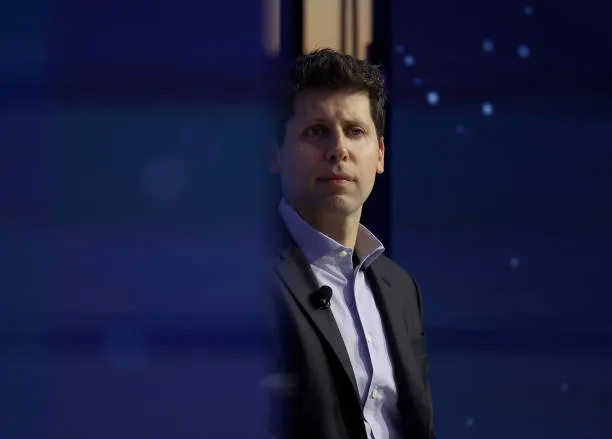
OpenAI CEO Sam Altman has openly discussed the massive computing power and electricity costs required to train advanced AI models like GPT-4, a significant factor in the high operating expenses for AI firms. (Source: gettyimages.com)
Red tape and global tensions
Governments worldwide are watching the AI industry more closely. Regulators worry about data privacy, biased algorithms, and too much market power. The EU passed the AI Act in March 2024. It puts strict rules on AI systems. These rules will make companies spend a lot on compliance and managing risks. This could slow down innovation. It might also raise operating costs for AI firms in the EU.
In the US, the Federal Trade Commission (FTC) has started investigating major AI players. These probes target potential monopolies and unfair competition. FTC Chair Lina Khan worried dominant tech firms were extending their power into AI. More oversight could mean fines, forced sales, or limits on business models. Such actions would hurt investor confidence and company values.
Global tensions also pose big risks to AI investments. The tech rivalry between the US and China directly affects the AI supply chain. The US government has limited advanced AI chip exports to China. This aims to slow China’s progress in AI and supercomputing. These controls hit chip makers like Nvidia and foundries like TSMC.
These limits create uncertainty in global markets for AI hardware and software. They can mess up supply chains and raise production costs. Chinese AI companies struggle to get the best chips for their models. This could split the global AI industry. That kind of split creates risks for companies wanting to work globally.
What AI investors should do now
Investors should carefully check AI companies’ basic business models. Look for firms with their own data, unique patents, or special expertise. These things give a lasting edge. Simple AI tools built on existing models might not be worth much long-term. Careful research is key in this fast-changing sector.
Diversifying your investments is still vital to lower risk. Don’t put all your money into a few risky AI startups. Think about a wider portfolio. Include established tech companies with proven ways to use AI. Judge companies on their ability to make real money and profit. Don’t just look at future potential. This helps you withstand market ups and downs.

Taiwan Semiconductor Manufacturing Company (TSMC) is the world's largest dedicated independent semiconductor foundry, producing the advanced chips essential for AI development. Its critical role in the global AI supply chain makes it a focal point for geopolitical tensions and export controls, directly impacting AI investment risks. (Source: reddit.com)
The AI sector will likely see innovation continue. It will also face market corrections. Some companies will surely deliver on their big promises. Others will struggle to make a profit or stand out. Investors should get ready for a changing landscape. Expect periods of fast growth and potential pullbacks. Ultimately, the winners will be companies with strong business plans and clear paths to making money. For everyone else, the AI gold rush could turn into a bust.
Common questions
What defines an investment bubble? An investment bubble happens when asset prices shoot up fast. Speculation often fuels this, pushing prices far beyond their real value. Investor excitement usually drives this unsustainable growth. It often ends in a sudden, sharp crash.
How does AI differ from the dot-com era? AI tech has clearer, immediate uses. It also shows real economic impact, unlike many early internet companies. But there are similarities: speculative valuations, a crowded market, and high spending on unproven business models.
Which sectors are most at risk? The most at-risk sectors include generative AI startups. They often have high burn rates and no clear way to make money. Companies whose value rests only on future promises, without much current revenue, are especially vulnerable.
What are key indicators of an AI bubble? Key indicators include very high price-to-earnings ratios. We also see huge VC money going into unproven companies. There is widespread excitement from everyday investors. Many startups offer similar products that don’t stand out.
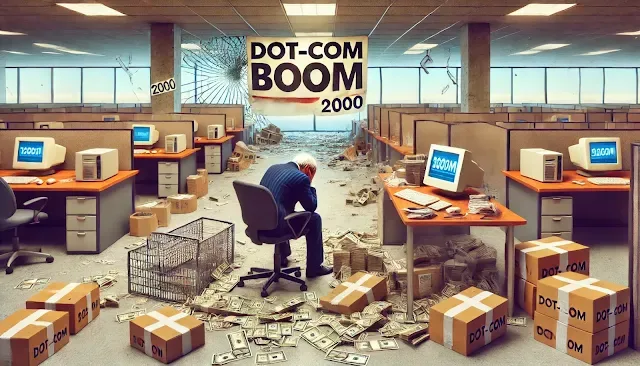
The dot-com bubble, which peaked in March 2000, saw internet-based companies reach extreme valuations before a dramatic market correction, wiping out billions in investor wealth and serving as a cautionary tale for new tech booms. (Source: economyprism.com)
You might also like:
👉 The $546 Billion Space Race: Private Money, Global Rivalries
👉 VIX: Wall Street’s 30-Day S&P 500 Fear Forecast
👉 Sustainable Futures: Investment, Cybersecurity & Future of Work