AI OCR: Why 1950s OCR's Ghost Haunts Modern Digitization
Many believe AI OCR has solved document digitization, but it hasn't. Discover why even advanced systems face significant challenges, despite OCR first appearing in the 1950s.
AI OCR isn’t done yet: The truth beyond perfect digitization
Many people believe that AI OCR has fully solved document digitization. This is not the case. Even advanced systems face significant challenges. AI OCR is not magic. It is a powerful tool, but it has demanding requirements to work effectively.
OCR first appeared in the 1950s. It converted scanned text images into machine-readable data. Early OCR engines used template matching. They struggled with varied fonts, sizes, and print quality. These systems were famously brittle. They often produced errors on anything but perfect, standardized documents. For decades, they mainly served niche uses, needing much human oversight.
AI, specifically machine and deep learning, began changing OCR in the 2000s. This moved OCR from matching characters to recognizing patterns and understanding context. Today, companies in finance, healthcare, and logistics use AI OCR. They process everything from invoices to medical records. The goal is still the same: automate data extraction from documents.
AI OCR’s real achievements
By 2023, the market for Intelligent Document Processing (IDP), including AI OCR, hit an estimated $2.1 billion. This growth shows real, concrete improvements over old OCR. AI OCR uses neural networks. These are trained on huge amounts of data. This helps it recognize characters and words much better than older systems. It learns to read different fonts, handwriting, and complex document layouts.
Traditional OCR would fail on a handwritten patient form. But modern AI OCR gets impressive accuracy even on tough cursive. Dr. Jianchang Mao, a Google AI researcher, showed this in a 2017 paper. He explained how deep learning models greatly improved recognition of messy text. This made once-impossible tasks possible. This ability directly cuts the need for constant human help in basic data capture.
Financial institutions especially gain from these improvements. McKinsey & Company reported in 2022 that AI OCR cut loan application processing times by up to 70%. It automatically pulls out key data like names, addresses, and financial figures from many document types. This frees staff to do more important work, like fraud detection or customer service, instead of endless data entry.

Dr. Jianchang Mao, a Google AI researcher, demonstrated in a 2017 paper how deep learning models significantly improved the recognition of messy, handwritten text, making once-impossible OCR tasks achievable for modern AI OCR systems. (Source: fellowsfundvc.com)
”Effortless” data extraction takes unseen work
Despite its progress, the common story often ignores the real work needed to use and keep AI OCR running. These systems aren’t “set it and forget it” solutions. They need big investments in data preparation, model training, and constant checks. Getting high accuracy often means more than just buying software.
First, AI OCR models need huge amounts of good, labeled training data. This data must match the exact documents an organization handles. For instance, training an AI for German utility bills is very different from training it for American insurance claims. A 2023 Forrester report on smart automation highlights this. It states that data preparation can take up to 80% of an AI project’s time. This means collecting, cleaning, and labeling millions of document images and text.
Second, AI OCR still struggles with edge cases and very different documents. It handles common layouts well. But anomalies cause big problems. Things like heavily damaged documents, faint print, or obscure regional formats trip it up. A 2021 study in the Journal of Imaging Science and Technology found a persistent 5-10% error rate. This was for AI OCR on highly degraded historical documents, even after much training. These errors mean humans still have to review, bringing back manual work.
Finally, a human-in-the-loop approach is vital for quality. Even the best AI OCR systems aren’t 100% accurate. This is especially true with sensitive or critical information. Companies like ABBYY, a major OCR seller, offer “validation stations” in their software. These tools let human operators quickly review, correct, and check extracted data. This step ensures data is correct. But it also adds a big manual part back into the process.
The semantic gap: AI OCR doesn’t truly understand
AI OCR is great at recognizing characters and words. But it often misses true context. Many people confuse character recognition with understanding meaning. This difference is key to knowing what the tech can and can’t do. An AI can read a word. It just doesn’t grasp its meaning or importance in a document.
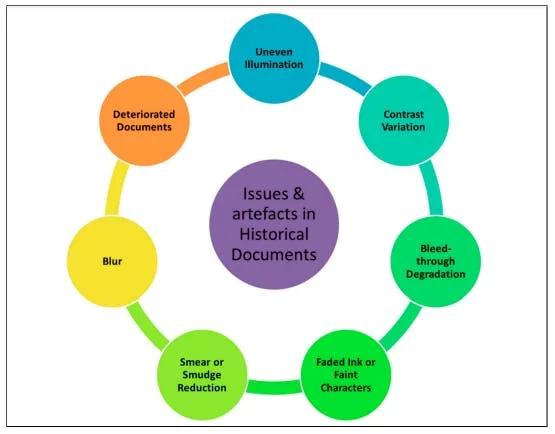
Even with extensive training, AI OCR systems struggle significantly with highly degraded historical documents, often yielding a persistent 5-10% error rate due to faint print, damage, or obscure formats. These 'edge cases' necessitate substantial human review, highlighting the unseen work behind 'effortless' data extraction. (Source: hackernoon.com)
Think about the number “100.” AI OCR can read the digits correctly. But it doesn’t know if “100” is a quantity, a street number, a temperature, or a discount. This kind of meaning requires more advanced natural language processing (NLP). These NLP tools often work separately from the main OCR engine. A 2022 IBM Almaden Research Center paper pointed out this gap. It said “document intelligence” is much more than just pulling out text. It needs to understand document structure and purpose.
Documents with very unstructured data are another hurdle. Think legal contracts, scientific papers, or open customer feedback. AI OCR alone can’t really extract specific clauses, identify parties, or summarize complex arguments. The British Library, for example, struggles to digitize its huge historical text collection. Its AI OCR models deal with old scripts, changing spellings, and specialized words. This often means custom training for each collection. It shows the specific knowledge AI OCR often lacks.
Multilingual documents are also tough. Many AI OCR systems support multiple languages. But their performance can differ a lot. An English-trained system might struggle with languages that have many word endings or non-Latin scripts, like Arabic or Japanese. Each language’s rich vocabulary and grammar needs its own, deep training data.
Security, bias, and ethics: The hidden costs
The push for AI OCR efficiency often hides key ethical, security, and bias issues. Organizations handling sensitive data need to do more than just extract text accurately. They must also think about the tech’s potential future effects. The common story rarely talks about these less exciting, but crucial, points.
Data privacy is a top concern. AI OCR systems often deal with documents that have personally identifiable information (PII). This includes names, addresses, social security numbers, and financial details. Errors or flaws in processing can lead to big data breaches. Rules like GDPR in Europe and CCPA in California set tough demands for data processors. Even small errors can mean fines and harm to a company’s name.

The British Library, one of the world's largest libraries, houses an immense collection of historical texts. Its struggle to digitize these documents due to old scripts and varying spellings highlights the specific knowledge AI OCR often lacks. (Source: thomasguignard.photo)
AI OCR models can also pick up and worsen biases from their training data. If an AI learns mainly from documents of one group or region, it might perform poorly on documents from others. Joy Buolamwini, an MIT Media Lab researcher, has shown this. She documented how AI bias, including text and image recognition, can cause unfair results. For instance, a system might struggle with documents from non-standard scripts or regional dialects. This impacts who can access services.
AI OCR systems themselves have security flaws. Cloud OCR services are handy, but they add outside risks. Data sent for processing could be stolen. Bad actors might also use flaws in AI models to change extracted data. Or they could inject harmful code into other systems. Companies must put strong security in place. This includes encryption, access controls, and regular checks to lower these risks.
The future: Augmented, not autonomous
AI OCR’s future won’t be fully automated or hands-off. It will be about smart augmentation. AI will boost human skills, not replace them entirely. The market for Intelligent Document Processing (IDP), including AI OCR, should reach $7.8 billion by 2028. This is according to a 2023 IDC Market Forecast. This growth shows ongoing investment in tools that mix AI with human work.
Companies hoping to “install and forget” AI OCR will hit big operational problems. Success depends on knowing what the tech can and can’t do. Organizations must invest in strong data rules, constant human checks, and smooth integration with current business processes. The goal isn’t 100% machine automation anymore. It’s about building very efficient, human-supervised systems.
This combined approach recognizes AI OCR’s power. It handles repetitive, high-volume tasks well. But it leaves complex interpretation and vital checks to human intelligence. For example, an AI might pull 90% of data from invoices with high confidence. The other 10% (edge cases, unclear fields) then go to a human for quick review and fix. This teamwork boosts efficiency and cuts errors. AI OCR’s real value is boosting human work, not making it useless.

Joy Buolamwini, an MIT Media Lab researcher, is a prominent advocate for AI ethics. She founded the Algorithmic Justice League to highlight and combat algorithmic bias, demonstrating how AI models can perpetuate and worsen societal inequalities. (Source: news.mit.edu)
Frequently asked questions
What’s the main difference between old OCR and AI OCR? Old OCR uses templates and rules to recognize characters. AI OCR uses machine and deep learning models. This lets it “learn” from data and adjust to different fonts, handwriting, and document layouts, giving it better accuracy.
Can AI OCR completely remove manual data entry? No, not in every case. It greatly cuts down manual work for structured documents and common formats. But complex, unstructured, or very different documents still need human checks and fixes. That’s because AI struggles with context and unusual situations.
What documents gain most from AI OCR? Documents with fairly consistent layouts and content benefit most. Think invoices, receipts, standard forms, and shipping manifests. AI OCR is great at pulling specific data fields from these.
Are there security risks with AI OCR? Yes, there are. Risks include data breaches when sensitive info is sent or processed. Biases in training data can also lead to unfair results. And the AI models themselves might have flaws that bad actors could use. Strong security and ethical thinking are key.
You might also like:
👉 Predicting Stock Market Trends: ML & Sentiment Analysis Guide
👉 Unmasking Online Bots: The X & Facebook Mimicry Challenge
👉 Sustainable Futures: Investment, Cybersecurity & Future of Work