Alien Material Found in Pacific: First Interstellar Touch
Humanity has touched alien material for the first time. Fragments of an interstellar object that hit Earth on January 8, 2014, were recovered from the Pacific Ocean.
We Found Alien Material on Earth
We found alien material on Earth. Fragments of an object from outside our solar system now rest in our labs, pulled from the Pacific Ocean floor. For the first time, humanity has touched something from another star system. This discovery confirms that interstellar objects do enter Earth’s atmosphere.
How we found it
On January 8, 2014, a small object hit Earth’s atmosphere. It was later called CNEOS 2014-01-08. The U.S. government detected its entry using classified sensor data. A fireball appeared off the coast of Papua New Guinea, near Manus Island. The object burned up over the Pacific Ocean.
In 2019, Harvard astrophysicist Dr. Avi Loeb and his student, Amir Siraj, noticed something strange about the object. They analyzed data from NASA’s Center for Near-Earth Object Studies (CNEOS). Their research showed the object moved at 45 kilometers per second relative to the Sun. This speed was much faster than anything usually tied to our solar system’s gravity.
That high speed strongly suggested it came from beyond our solar system. The object’s material also seemed unusually strong. Loeb and Siraj submitted their findings for peer review. The scientific community could not confirm its interstellar origin, as the U.S. Department of Defense held the classified data.
On April 6, 2022, the U.S. Space Command (USSC) officially confirmed the object’s interstellar origin. Lt. Gen. John E. Shaw, then Deputy Commander of USSC, released a memo. He said the speed anomaly alone showed it came from outside our solar system. This confirmed Loeb and Siraj’s earlier idea. The object, now called IM1, became the third confirmed interstellar visitor, after ‘Oumuamua and Borisov.
The search for fragments
After the USSC confirmation, Dr. Avi Loeb organized an ocean expedition. His Galileo Project at Harvard University led the effort. Their goal: find and retrieve fragments of CNEOS 2014-01-08 from the ocean floor. Private donors funded the expedition, which cost about $1.5 million.
In June 2023, the research vessel Silver Star left Papua New Guinea. The crew sailed to a 10-square-kilometer area identified by CNEOS data. This spot was about 45 kilometers north of Manus Island. The team used a magnetic sled with cameras and lights. It trawled the ocean floor, reaching depths of 1.7 kilometers.
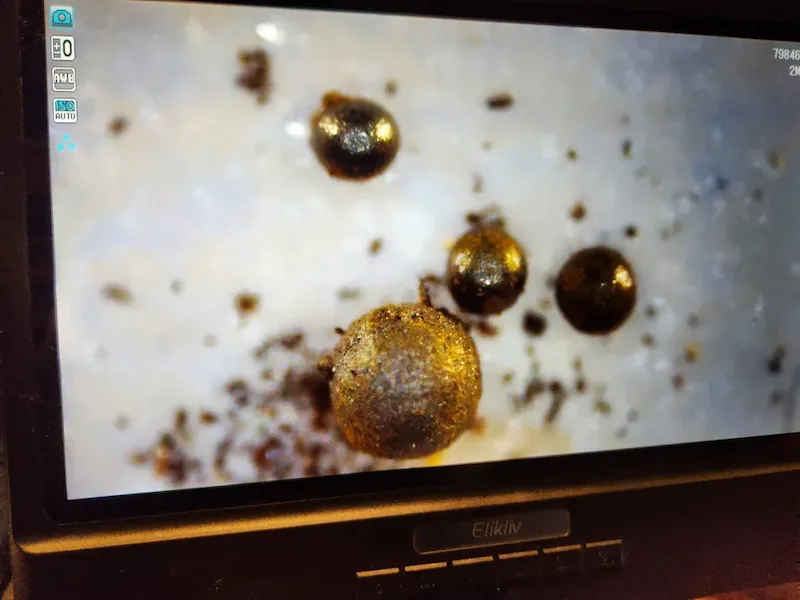
These tiny metallic spherules, retrieved from the Pacific Ocean floor near Papua New Guinea, are believed to be fragments of IM1, the first interstellar object ever recovered on Earth. Their unique composition and high material strength offer unprecedented insights into objects originating from beyond our solar system. (Source: earthsky.org)
The expedition found about 700 tiny metallic spherules. These microscopic spheres, up to 0.7 millimeters across, lay along the predicted impact path. The team used a powerful magnet to collect them. They concentrated in an area called “the anomaly zone.”
Initial analysis happened right on the Silver Star. The team used a mass spectrometer to find their elemental makeup. They found high levels of iron, titanium, and magnesium. While these elements are common in meteorites, their ratios were unusual.
Later lab analysis at Harvard University confirmed their unique makeup. The spherules had very low nickel levels compared to typical meteorites. They also showed extreme material strength, stronger than any space rock NASA had studied before. Dr. Loeb reported these findings in July 2023. He called the material “anomalous,” different from any known alloy on Earth or from our solar system.
What this means for science
These retrieved spherules are the first physical samples from another star system. This discovery advances astrophysics and material science. Scientists can now study the makeup of objects formed in alien stellar environments. It gives us direct evidence of conditions beyond our sun.
The unusual strength of IM1 (CNEOS 2014-01-08) is significant. Dr. Loeb suggests it could even be an engineered artifact. He cautions against jumping to conclusions. We need more data to know its exact origin and nature. The Galileo Project specifically wants to investigate objects that might be alien technology.
This recovery also improves our understanding of interstellar objects. ‘Oumuamua, found in 2017, was the first confirmed visitor. Borisov, a comet, came next in 2019; direct sampling of either was not possible. The IM1 spherules provide a unique opportunity. They offer insight into how other planetary systems form.
Future research will focus on isotopic analysis of the spherules. Scientists will measure the ratios of different isotopes of elements like iron and oxygen. These ratios act like fingerprints. They reveal the specific stellar environment where the material formed. This data could pinpoint the type of star system IM1 came from.

Dr. Avi Loeb, a Harvard astrophysicist, led the expedition to retrieve fragments of IM1, an interstellar object. He reported its unusual strength and suggested it could potentially be an engineered artifact, driving further scientific inquiry. (Source: nieman.harvard.edu)
The Galileo Project plans more expeditions. They will target other potential interstellar objects. Dr. Loeb pushes for a systematic search for alien artifacts. He believes this could greatly advance our understanding of life in the universe. Such research needs serious funding and global scientific teamwork.
Questions you might have
What is an interstellar object? It’s a natural or artificial body from outside our solar system. It travels through space, not held by our Sun’s gravity. These objects are rare visitors to our cosmic neighborhood.
How did we know this object was interstellar? We identified CNEOS 2014-01-08 by its extreme speed relative to the Sun. Its velocity was so high it couldn’t have come from within our solar system. The U.S. Space Command officially confirmed its interstellar path.
Why is this recovered material important? These spherules are the first physical samples from another star system. Their unique makeup and strength offer clues about conditions beyond our solar system. They might even hint at advanced alien technology.
Does this relate to alien life? The current spherule data doesn’t directly prove alien life. Their unique composition is the main discovery for now. More analysis is needed to understand all their implications, including a potential artificial origin.

The research vessel Silver Star, utilized by the Galileo Project, played a crucial role in the expedition to recover fragments of the interstellar object IM1 from the Pacific Ocean floor. Such specialized ships are equipped with advanced technology for deep-sea exploration and recovery, enabling the search for rare cosmic visitors. (Source: yachtbuyer.com)
You might also like:
👉 Tucker Carlson on Aliens: UFOs, UAP & Media Discourse
👉 Unexplained Mysteries of Science: Cosmos, Quantum & Beyond
👉 The $546 Billion Space Race: Private Money, Global Rivalries