
The 1995 Click That Started the Consumer Data Revolution
From a Bellevue garage in July 1995, Jeff Bezos' Amazon.com began recording every click, forever changing how businesses understand buyers.
The invisible architects: how technology reshaped consumer behavior
In July 1995, Jeff Bezos launched Amazon.com from a small Bellevue, Washington garage. He sold his first book: Douglas Hofstadter’s Fluid Concepts and Creative Analogies. That single sale held a quiet promise. It hinted at a future where every click, view, and purchase would be recorded.
For centuries, knowing why people bought things was an art. Businesses relied on intuition, direct feedback, and sales numbers. They ran surveys and focus groups. They tried to grasp what drove individual choices. This understanding, known as consumer behavior, powered all commerce.
Then, digital technology changed everything. It offered tools to watch, analyze, and even predict these behaviors. This started a new era. What we bought, and why, would never be the same.
The first digital footprints: cookies and clickstreams
By the late 1990s, the internet grew quickly past academic circles. Companies like Netscape and Microsoft raced to bring web browsers to every home. As more people logged on, businesses faced a new challenge: understanding their digital customers.
In 1994, Netscape programmer Lou Montulli invented the HTTP cookie. This small text file, stored on a user’s computer, let websites remember information. It recalled login details, shopping cart contents, or past visits. For the first time, a website could “recognize” a returning user.
Early e-commerce sites, including Amazon, quickly adopted cookies. They tracked pages a user visited and products they viewed. This data, called “clickstream data,” gave basic information. It showed what users did on a specific website. It didn’t reveal why.
This early data collection was basic. It was often isolated on individual websites. Still, it was a big change. Businesses now had a direct, though limited, look at user actions online. This opened the door for better tracking.
Mapping the digital consumer: aggregation and early personalization
The early 2000s saw web activity explode. Google, founded in 1998, quickly became the top search engine. Social media platforms like MySpace and later Facebook gained huge user numbers. These changes created huge new data pools.
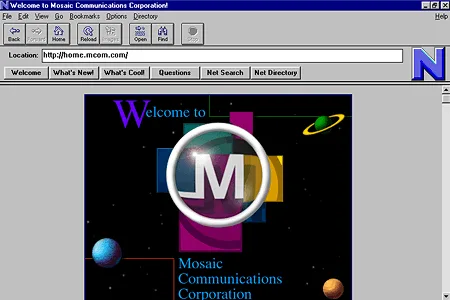
Launched in 1994, Netscape Navigator was one of the first widely used web browsers, playing a crucial role in bringing the internet to homes and enabling the 'first digital footprints' like HTTP cookies. Its iconic interface defined the early online experience for millions. (Source: webdesignmuseum.org)
In November 2005, Google launched Google Analytics. It gave website owners free tools to track visitor traffic, bounce rates, and conversion goals. This gave everyone access to data. Small businesses could now analyze their websites like big companies. The focus shifted from just being online to tracking measurable engagement.
Companies also started collecting data from many places. Online advertising networks, such as DoubleClick (Google bought it in 2007), tracked user activity across many websites. They used cookies to create interest profiles. This let advertisers show ads to specific groups. Someone browsing car reviews, for example, might see ads for new vehicles.
This era started early personalization. Netflix, famously, launched its Netflix Prize in 2006. It offered $1 million to improve its movie recommendation algorithm. This showed how powerful data was to predict individual tastes. These systems aimed to guess what a customer might want next.
Businesses began to connect different pieces of information. They tried to build a fuller picture of their customers. This brought them closer to understanding not just what was happening, but who was doing it.
The mobile revolution: immediate understanding and online/offline blending
Apple’s iPhone, launched in 2007, changed consumer behavior completely. It put the internet, apps, and powerful sensors right into people’s pockets. By 2014, 25% of the world’s population had a smartphone, says Statista. This created a huge new chance for data collection.
Mobile devices generated a steady flow of data. Location services tracked physical movements. App usage patterns showed daily routines. Social media interactions gave immediate feelings. Businesses could now understand consumers not just online, but all day long.
Retailers started combining online and offline data. They wanted an understanding across all channels. In 2013, Macy’s tried beacons in its stores. These small Bluetooth devices communicated with customer smartphones. They sent personalized offers or guided shoppers through departments. This mixed digital with physical shopping.
Salesforce and other CRM systems did more. They combined sales, marketing, and customer service data from all channels. Starbucks, for example, used its mobile app to track customer preferences and reward loyalty. Its mobile payment system, launched in 2011, gave detailed transaction data.
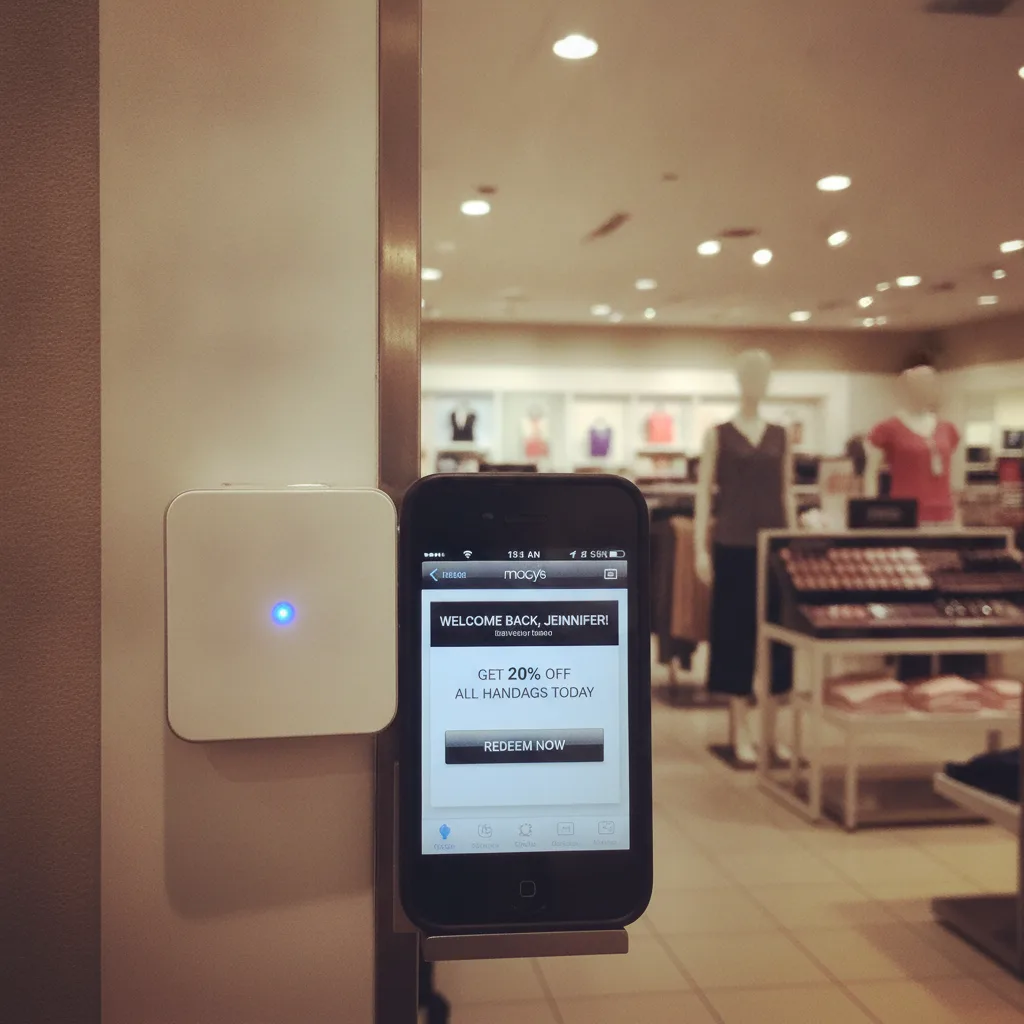
In 2013, Macy's experimented with small Bluetooth beacons in its stores. These devices communicated with customer smartphones, sending personalized offers and guiding shoppers, illustrating the early blending of digital and physical retail experiences. (AI-generated illustration)
This era gave businesses a much better, immediate understanding of consumers. It let them reach customers at the right times and places. The line between online and offline behavior blurred more and more for marketers.
AI’s predictive power: anticipating consumer desires
By the mid-2010s, Artificial Intelligence (AI) and machine learning started changing consumer behavior technology. Algorithms could process huge amounts of data, more than humans ever could. They found hidden patterns and made smart predictions. The focus shifted from watching past actions to predicting future ones.
Companies like Amazon poured money into AI for recommendation engines. Their algorithms looked at purchase history, browsing, and even how long users paused on products. This let them suggest items with amazing accuracy. In 2016, Amazon reported that AI-driven recommendations made up a big part of their sales.
Natural Language Processing (NLP), an AI subfield, let businesses analyze huge amounts of text data. This included customer reviews, social media comments, and call center transcripts. Brands could measure public feeling about products or find new trends. IBM’s Watson, for instance, offered services for sentiment analysis.
In physical retail, computer vision technology became popular. Cameras in stores could analyze foot traffic patterns, shelf interactions, and even shopper demographics (anonymously). Companies like Everseen used AI to detect checkout errors and prevent loss. This gave understanding into store behavior that were once hard to get.
AI let businesses go past simple groups. They could now predict individual customer needs. This led to super-personalized marketing and anticipatory customer service. It changed how companies talked to their customers.
The ethical crossroads: privacy, regulation, and trust
As AI’s power grew, so did public concern about data privacy. Consumers became more aware of the huge amounts of information collected about them. This made people demand more transparency and control. Regulators began to act.
In May 2018, the European Union launched the General Data Protection Regulation (GDPR). It gave individuals significant rights over their personal data. Companies had to obtain clear consent for data collection. They also had to explain how data was used. Failure to comply meant big fines.

IBM Watson gained widespread public recognition after defeating human champions on the quiz show Jeopardy! in 2011, showcasing its advanced natural language processing and question-answering capabilities that later found applications in consumer behavior analysis. (Source: tvinsider.com)
The United States followed with the California Consumer Privacy Act (CCPA) in January 2020. This law gave Californians rights to know what data was collected about them. It let them ask for deletion and opt out of its sale. Other states soon introduced similar laws.
Major tech companies also started listening to privacy demands. In 2021, Apple introduced App Tracking Transparency (ATT). This feature made apps ask users for permission to track their activity across other apps and websites. This significantly impacted the mobile advertising industry. Google also announced plans to get rid of third-party cookies in its Chrome browser by 2024.
This era forced a re-evaluation of data practices. Tech developers started building privacy into their designs. They tried new methods like federated learning and synthetic data. These methods let them get information without revealing user data. The conversation shifted from “how much data can we collect?” to “how can we use data responsibly and ethically?”
The future: understanding situations and anticipatory engagement
Looking ahead, consumer behavior technology will keep changing. The focus will move even more from just prediction to understanding context and intent. Rather than simply knowing what a consumer might do, technology will try to understand why they act in a specific moment.
Conversational AI and advanced voice assistants will become smarter. They will understand natural language better. This makes interactions feel more natural. Imagine a voice assistant that recommends products and understands your mood and buying intent from your tone. This goes beyond simple keywords.
Edge computing will process data closer to its source, on devices themselves. This reduces latency and improves privacy. Your smart device might analyze your habits locally. It only sends combined, anonymous information to a central server. This allows for highly personalized experiences without always talking to the cloud.
Trust will become a key difference for brands. Consumers will increasingly choose companies that show transparency and respect for their data. Technologies like blockchain could offer verifiable ways for consumers to control who uses their data. They could grant access on a detailed, time-limited basis.

The passage describes future voice assistants that understand mood and buying intent, moving beyond simple keywords. Devices like Amazon Echo, Google Home, and Apple HomePod are at the forefront of this technology, constantly evolving to offer more natural and intuitive interactions. (Source: dreamstime.com)
The future envisions a world where technology provides smooth, helpful, and respectful intelligence. It anticipates needs, offers relevant solutions, and simplifies decisions. It will do this while giving people more control over their digital selves. This next phase of consumer behavior technology promises a closer relationship between people and the brands that serve them.
FAQ
Q: What is consumer behavior technology? A: It’s the digital tools and platforms businesses use. They observe, analyze, predict, and influence how consumers interact with products, services, and brands. This includes everything from basic website tracking to advanced AI prediction models.
Q: How do companies collect consumer data? A: Companies collect data through website cookies, mobile app usage, social media interactions, loyalty programs, in-store sensors, and direct surveys. They also get data from third-party data brokers who combine information from many sources.
Q: What are the main benefits of using this technology for businesses? A: Businesses use it to personalize marketing messages, improve product recommendations, optimize pricing, enhance customer service, and find new market trends. It helps them make informed decisions that can increase sales and customer satisfaction.
Q: What are the primary concerns regarding consumer behavior technology? A: Key concerns include privacy violations, potential data breaches, and the use of personal data for manipulative advertising. Algorithmic bias is another worry. Regulations like GDPR and CCPA aim to address these issues by giving consumers more control over their information.
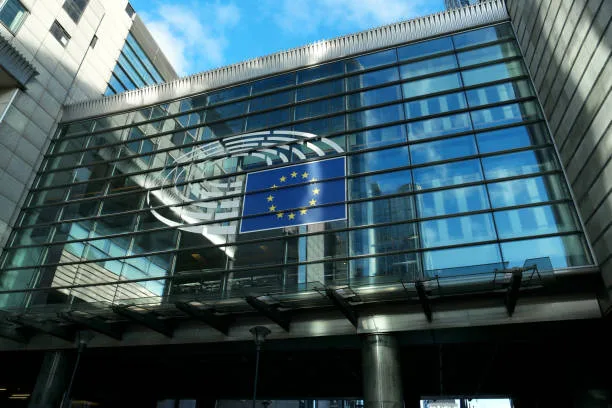
The General Data Protection Regulation (GDPR), enacted by the European Union in 2018, is a landmark data privacy law that gives individuals more control over their personal data and holds companies accountable for how they collect, store, and process it. (Source: gettyimages.com)
You might also like:
👉 The 2016 Shift: How Phones Became AI Companions
👉 Zuckerberg’s 2021 Meta: Why Your Virtual Self Isn’t Free
👉 The Future of DeFi Protocols: Navigating Web3’s Financial Revolution