70 Years On: Fusion Energy's Breakthroughs for Limitless Power
Scientists have pursued fusion energy for over 70 years, aiming to replicate the sun's process for clean, limitless power. Recent breakthroughs hint at a new era.
Fusion Energy: Our Shot at Limitless Power
Nuclear energy often brings to mind fission – splitting heavy atoms, as in today’s reactors. Nuclear fusion is different. It is the opposite process: combining light atoms, just like the sun. This simple difference holds the key to a future where clean, abundant energy powers our world.
Fusion energy copies the sun’s process. It offers a limitless, clean energy source. Scientists have pursued this goal for over 70 years. Recent breakthroughs hint we are closer than ever.
What fusion is, and why it matters
Fusion energy forces two light atomic nuclei to merge. This creates a single, heavier nucleus. This process releases huge energy. The fuel is hydrogen isotopes: deuterium and tritium. Deuterium comes from seawater. We can make tritium from lithium, which is also plentiful.
Imagine pushing two strong magnets together. Their poles face the same way. They fight back. Atomic nuclei, with their positive charges, do the same. To overcome this repulsion, we need extreme conditions. We must heat the fuel to hundreds of millions of degrees Celsius. We also need immense pressure.
When conditions are right, the hydrogen isotopes fuse. They form a helium nucleus. This also releases a high-energy neutron. This neutron carries away the fusion energy. We then capture this energy for electricity. It produces no long-lived radioactive waste. It carries no meltdown risk.
Fusion energy is pursued globally. Major international projects, such as the International Thermonuclear Experimental Reactor (ITER) in Cadarache, France, are developing fusion. ITER is a collaboration involving 35 nations. These include the European Union, India, Japan, China, Russia, South Korea, and the United States. Its construction started in 2007. First plasma operations should begin in 2025. Private companies are also speeding up. They attract big money.
The difficult science: making a star on earth
Creating a mini-star on Earth is difficult. The fuel must reach temperatures exceeding 150 million degrees Celsius. That is ten times hotter than the sun’s core. At these extreme temperatures, matter becomes plasma. Plasma is an ionized gas. Electrons separate from atomic nuclei.
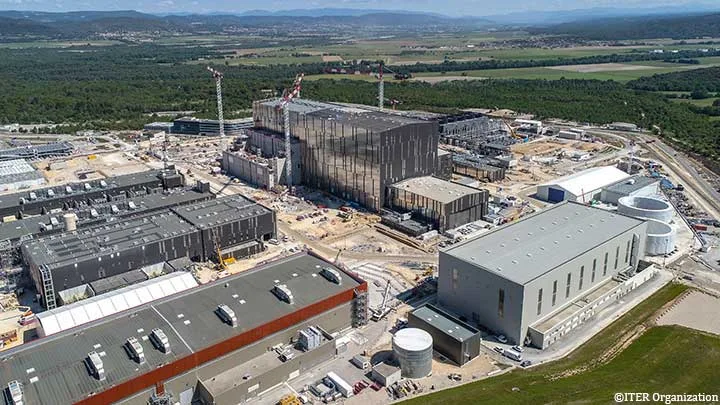
The International Thermonuclear Experimental Reactor (ITER) in Cadarache, France, is a massive global collaboration involving 35 nations to develop fusion energy. Its construction began in 2007, with first plasma operations anticipated in 2025. (Source: man-es.com)
Keeping this superheated plasma stable and contained is the main problem. Scientists use two main approaches. One is magnetic confinement fusion (MCF). The other is inertial confinement fusion (ICF). Both try to hold the plasma together long enough to fuse. They also need to make more energy than they use.
Magnetic confinement fusion typically uses devices called tokamaks or stellarators. A tokamak is a doughnut-shaped vacuum chamber. Powerful magnetic fields trap the hot plasma inside. These fields stop the plasma from touching the reactor walls. The Joint European Torus (JET) in the UK is an important tokamak. It began operations in 1983. Stellarators use more complex, twisted magnetic coils to stabilize plasma. The Wendelstein 7-X stellarator in Germany is a notable example.
Inertial confinement fusion takes a different path. It uses high-power lasers or particle beams. These beams rapidly heat and compress a small fuel pellet. The pellet implodes. This creates the extreme conditions needed for fusion. The National Ignition Facility (NIF) at Lawrence Livermore National Laboratory (LLNL) in the United States shows this method. NIF uses 192 powerful lasers. They focus on a tiny target capsule.
Recent breakthroughs and lingering hurdles
December 5, 2022, marked an important day for fusion research. Scientists at the NIF achieved “net energy gain” for the first time. They directed 2.05 megajoules (MJ) of laser energy at a fuel target. This generated 3.15 MJ of fusion energy output. Dr. Kim Budil, LLNL Director, confirmed it. It proved fusion ignition is possible. This was a scientific breakthrough, not yet an engineering one.
The NIF achievement showed an important step: Q>1. This means the fusion reaction itself produced more energy. This was more than the energy delivered to the target. But the lasers needed much more total energy to fire. It took hundreds of megajoules of electricity to power the NIF facility. Scaling this up for practical power generation is still difficult.
Magnetic confinement has also made big progress. In 2021, the JET facility achieved a world record. It produced 59 megajoules of sustained fusion energy over five seconds. This was an important step for deuterium-tritium fuel. Dr. Tony Donné, Programme Manager for EUROfusion, said this showed reliable fusion power is possible. ITER, once operational, aims to produce 500 MW of fusion power. This would come from 50 MW of input heating power. This would be a ten-fold energy gain (Q=10).
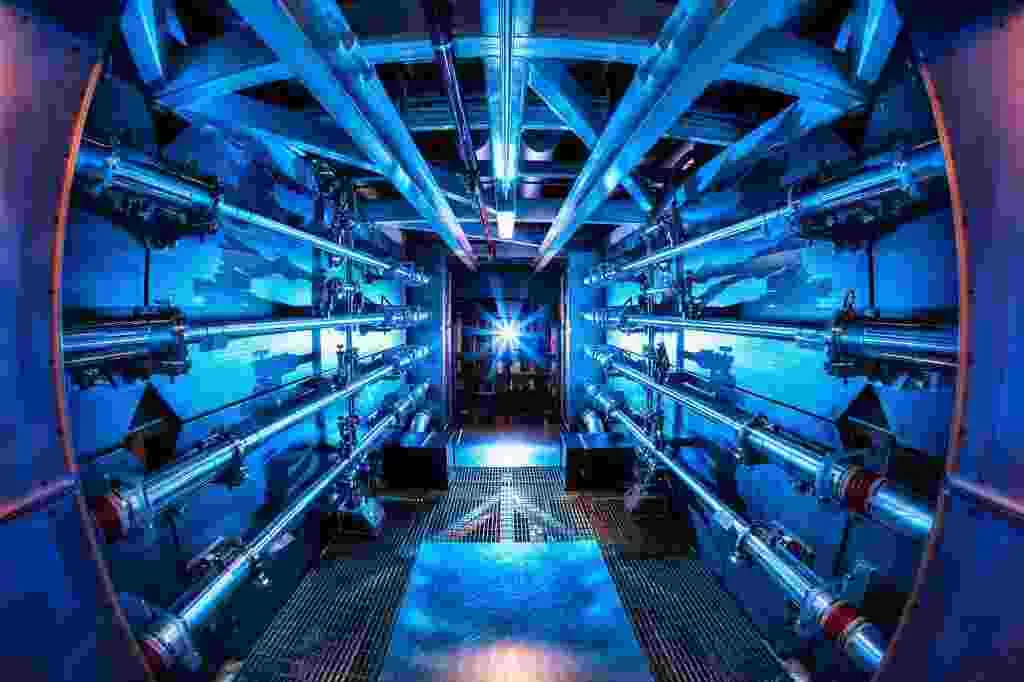
The National Ignition Facility (NIF) at Lawrence Livermore National Laboratory achieved a historic milestone on December 5, 2022, by demonstrating net energy gain from a fusion reaction for the first time, proving fusion ignition is possible. (Source: photek.com)
Despite these successes, several problems remain. Material science is a big problem. Reactor walls must withstand extreme heat and neutron bombardment. Safely handling and breeding tritium is another challenge. Tritium is radioactive and scarce. Future reactors will need to produce their own tritium. Developing strong, cost-effective magnets and heating systems is also important. These components must operate reliably for decades.
The promise: why fusion matters for our future
Fusion energy has significant benefits for global energy security and climate change. Its main fuel, deuterium, comes from water. Water is available to all nations. This means no single country could monopolize fuel supplies. It provides an endless energy source. Dr. Arati Prabhakar, White House science advisor, said fusion could provide “clean power for the future of the planet.”
Unlike fission, fusion reactions produce no long-lived radioactive waste. The byproducts are short-lived. They typically decay to safe levels within decades, not millennia. There is also no risk of a runaway chain reaction. If something goes wrong, the plasma simply cools. The fusion reaction stops immediately. This built-in safety eases many public worries about fission.
Private industry is now speeding up fusion development. Companies like Commonwealth Fusion Systems (CFS), an MIT spin-off, are building compact, high-field tokamaks. CFS aims for net energy gain by 2025 with its SPARC project. They use new high-temperature superconducting magnets. Helion Energy in the US plans to sell fusion electricity by 2028. They use a magnetic mirror confinement approach. These private ventures bring new money and urgency.
The cost of building fusion power plants remains high. But operational costs could be low thanks to cheap fuel. The long-term environmental benefits are very large. Fusion produces no carbon emissions. It could replace fossil fuels as a main energy source. This would slash greenhouse gas emissions. It would also help stabilize energy markets worldwide.
The road ahead: from laboratory to grid
The next decade will be important for fusion energy. ITER is on track for first plasma in 2025. It will test the physics of a burning plasma on a huge scale. Data from ITER will guide the design of future commercial reactors. These reactors are often called “DEMO” plants. DEMO plants aim to generate continuous electricity.
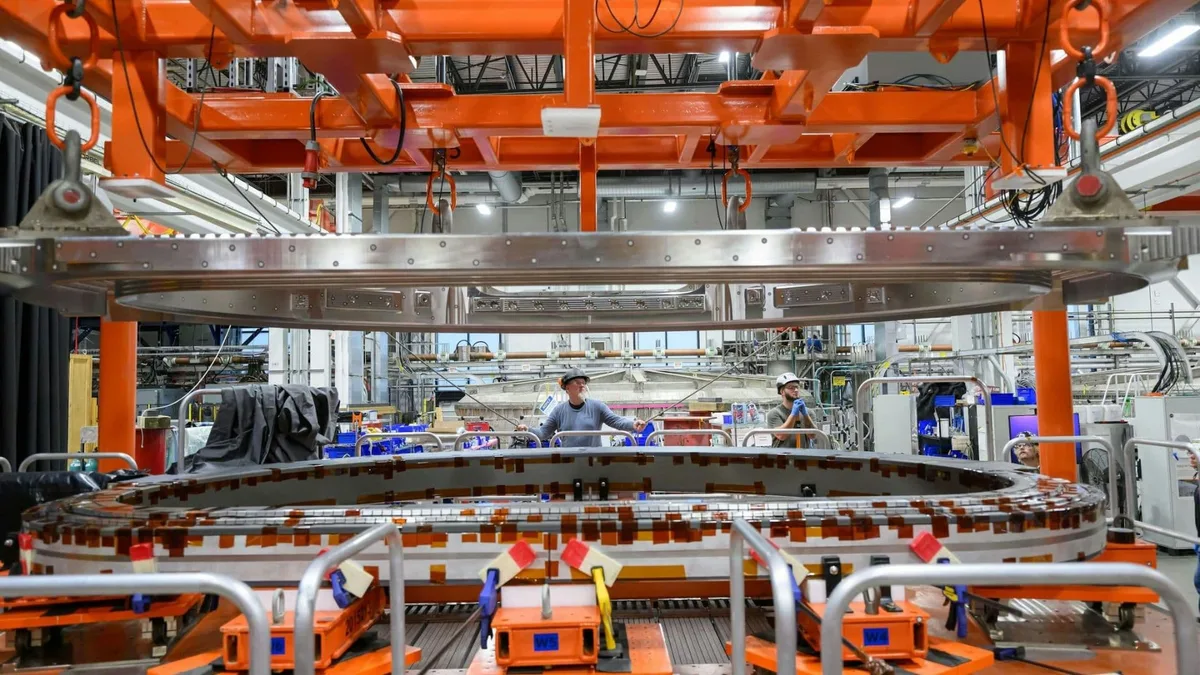
The SPARC tokamak, developed by Commonwealth Fusion Systems (CFS), an MIT spin-off, aims to achieve net energy gain by 2025 using revolutionary high-temperature superconducting magnets, representing a major step in private sector fusion development. (Source: interestingengineering.com)
Private companies are setting ambitious timelines. CFS targets commercial electricity generation by the early 2030s. Helion Energy aims even sooner. Their progress depends on more scientific breakthroughs and engineering solutions. Scaling up laboratory results to industrial power plants needs big investment. It also needs ongoing international teamwork.
Scientists are also researching other fusion approaches. These include magnetic mirrors, field-reversed configurations, and inertial electrostatic confinement. Each approach has its own advantages and challenges. This diverse research increases the likelihood of finding the best path to commercial fusion. Dr. Melanie Windridge, a UKAEA physicist, stresses the need for diverse approaches. No single path is guaranteed, she says.
Achieving practical fusion power will change global energy. It offers a clean, safe, and endless solution for our energy needs. The journey from scientific curiosity to commercial power has been long. But recent successes give real hope. The dream of building a star on Earth is almost real. If we succeed, the energy problems of tomorrow could simply vanish.
FAQ
What is the difference between nuclear fission and fusion? Fission splits heavy atoms, like uranium, to release energy. Fusion combines light atoms, like hydrogen, to release energy. Fusion is the process that powers the sun.
Is fusion energy radioactive? Fusion produces no long-lived radioactive waste. Reactor components themselves can become activated by neutrons. However, this induced radioactivity decays quickly, within decades.
When will fusion power be ready? Scientists and companies offer varying timelines. Some private companies aim for commercial power in the late 2020s or early 2030s. Larger international projects like ITER anticipate full operation by 2035.
What fuel does fusion energy use? Most current fusion concepts use deuterium and tritium, both hydrogen isotopes. Deuterium is extracted from water. Tritium can be bred from lithium, which is also abundant.

Dr. Melanie Windridge, a UKAEA physicist, is a leading voice in fusion energy, emphasizing the importance of diverse research approaches to achieve commercial fusion power. She is also a noted author and science communicator. (Source: skyatnightmagazine.com)
You might also like:
👉 Understanding Energy Independence: Security, Economy, Future