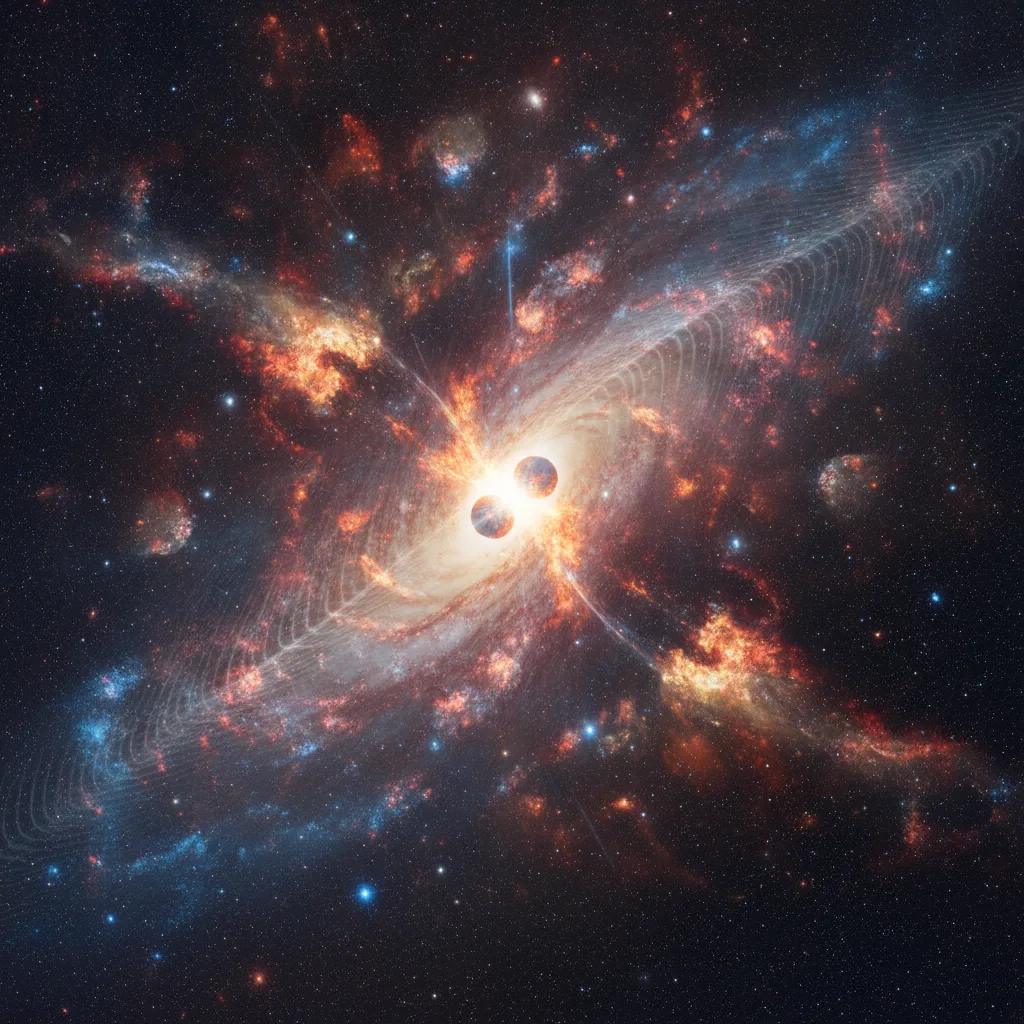
GW170817: The 2017 Kilonova That Unlocked Cosmic Secrets
Witness the groundbreaking GW170817 kilonova, the first direct detection of gravitational waves from merging neutron stars with an electromagnetic counterpart.
The Rarest Celestial Events
On August 17, 2017, a cosmic event changed our understanding of the universe. Scientists observed GW170817, a kilonova. This was the first direct detection of gravitational waves from merging neutron stars. It also had an electromagnetic counterpart. This simultaneous observation began a new era of “multi-messenger” astronomy.
What defines a “rare” celestial event? These phenomena occur infrequently. They might happen only once in many human lifetimes. Sometimes, they require specific cosmic alignments. These events reveal physics under extreme conditions. They test our understanding of the universe.
Astronomers and astrophysicists worldwide study these occurrences. Major space observatories, like the Hubble Space Telescope, aid this research. Ground-based facilities also play a vital role. The European Southern Observatory’s Very Large Telescope (VLT) in Chile is an example. Dr. Vicky Kalogera, an astrophysicist at Northwestern University, emphasizes their importance. She states these events are key to understanding how heavy elements form.
Scientists primarily observe these events using advanced telescopes. These instruments cover the entire electromagnetic spectrum. Gravitational wave detectors, such as LIGO and Virgo, add a new way to observe. They detect ripples in spacetime. This allows us to detect events invisible to light.
Glimpses of the Impossible
The transit of Venus across the Sun is a rare planetary event. It happened only twice in the 21st century: in 2004 and 2012. Orbital mechanics dictate these specific pairings. The next transit will not occur until December 2117.
The 2017 kilonova, GW170817, involved two neutron stars merging. This merger took place 130 million light-years away. It occurred in the galaxy NGC 4993. The LIGO-Virgo collaboration first detected its gravitational waves. Telescopes then captured its optical and X-ray emissions.
Dr. Patrick Brady, a spokesperson for the LIGO Scientific Collaboration, called GW170817 a “new era.” It confirmed that neutron star mergers create heavy elements. Gold and platinum likely originate from such events. This important observation appeared in Physical Review Letters.
Another rare phenomenon involves hypervelocity stars. These stars are ejected from galactic centers at extreme speeds. Star S5-HVS1 races through space at over 1,700 kilometers per second. Discovered in 2019, its speed is enough to escape the Milky Way’s gravity.
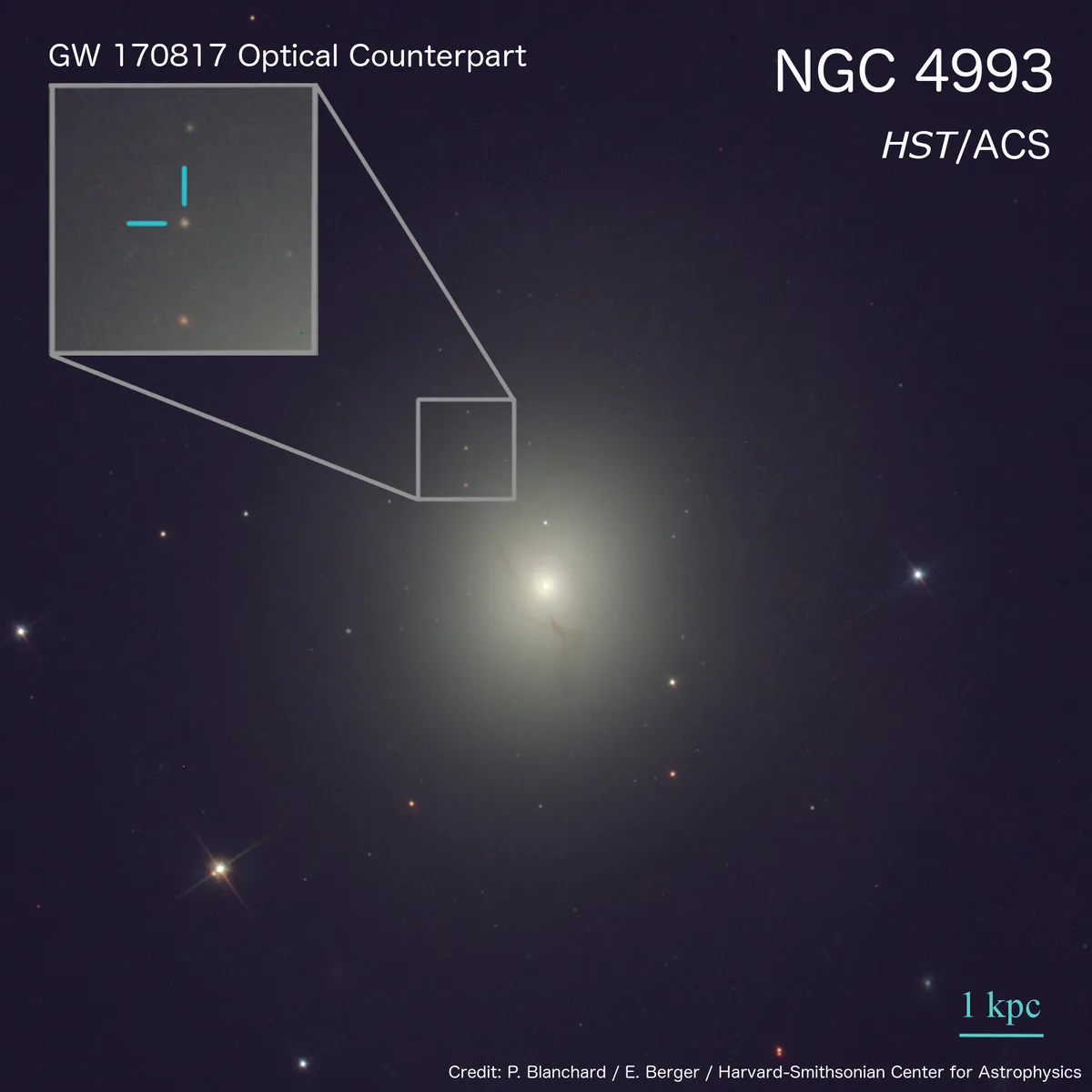
The galaxy NGC 4993, located 130 million light-years away, was the site of GW170817, the first observed kilonova. This merger of two neutron stars in 2017 provided the first direct detection of gravitational waves and electromagnetic radiation from such an event, confirming the origin of heavy elements like gold and platinum. (Source: cfa.harvard.edu)
Sagittarius A*, the supermassive black hole at our galaxy’s center, caused this star’s acceleration. Dr. Douglas Boubert of the University of Oxford described its trajectory. Such stellar ejections are infrequent. They happen perhaps once every 100,000 years.
Ultra-Long Gamma-Ray Bursts (GRBs) are another rare class. Most GRBs last only a few seconds. However, GRB 110328A lasted over 10,000 seconds. NASA’s Swift satellite observed this unusual duration. Its prolonged emission suggests a unique origin.
Researchers linked GRB 110328A to a tidal disruption event. A black hole likely tore apart a passing star. Dr. Andrew Levan from the University of Warwick published findings on this. We rarely see such extreme black hole interactions directly.
Gravitational lensing creates distorted images of distant objects. A massive foreground object bends their light. The Einstein Cross, QSO 2237+0305, is a good example. It shows four distinct images of a single quasar. A massive foreground galaxy perfectly aligns to act as a lens.
Hubble Space Telescope observations confirm this phenomenon. Dr. John Huchra first described its unique nature in 1985. This perfect alignment is very uncommon. It offers a rare look at spacetime distortion.
The Search Continues
The Vera C. Rubin Observatory in Chile will open in 2025. Its Legacy Survey of Space and Time (LSST) camera is powerful. It will scan the entire visible sky every few nights. This creates a cosmic movie. The observatory will enable many more discoveries.
Scientists hope to find new types of supernovae. They also expect to see exotic, short-lived stellar events. The LSST will detect sky changes never before seen. This constant monitoring is key to catching fleeting events.
The European Space Agency’s Euclid mission launched in 2023. It maps the universe’s dark matter and dark energy. Euclid could indirectly reveal rare gravitational lensing events. Its wide field of view provides new data. This data will improve our understanding of cosmic structures.
Future gravitational wave detectors promise more discoveries. The Laser Interferometer Space Antenna (LISA) is one such project. LISA will be a space-based observatory. It will detect gravitational waves from supermassive black hole mergers. We predict these events, but have not directly observed them yet. Dr. Karsten Danzmann leads the LISA Pathfinder mission, a precursor to LISA. LISA should launch in the mid-2030s.
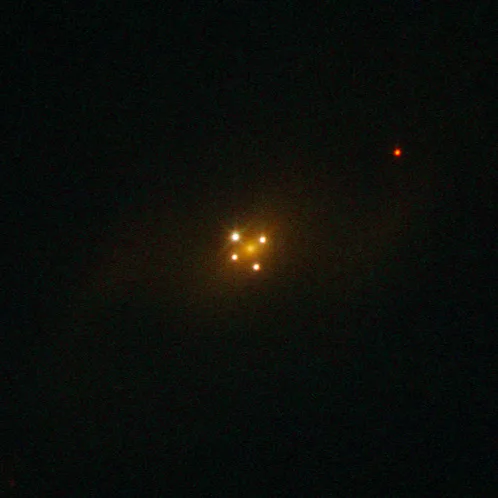
The Einstein Cross is a rare and stunning example of gravitational lensing, where a massive foreground galaxy perfectly aligns to bend the light from a single distant quasar, creating four distinct images of it around the galaxy's core. (Source: en.wikipedia.org)
Anticipating the Unseen
We have never visually confirmed a binary black hole merger. The LIGO and Virgo collaborations detect gravitational waves from these mergers. These detections are now somewhat regular. But they produce no light, making them visually elusive.
Astronomers are building larger, more sensitive telescopes. These instruments will help us see more. The Thirty Meter Telescope (TMT) is under construction. The European Extremely Large Telescope (E-ELT) is another ambitious project. These telescopes will offer incredible detail.
These future instruments will allow us to survey the sky deeper and faster. They could catch the faint afterglows of events. This includes kilonovae from much farther distances. Catching these short-lived emissions requires a quick response.
The scientific community keeps developing multi-messenger observatories. This approach combines data from many sources. The goal is simultaneous data from gravitational waves, light, and neutrinos. This broad view helps us understand events better. The next truly rare celestial event remains unknown. However, scientists are ready. They will observe it across many cosmic messengers.
FAQ
What makes a celestial event “extremely rare”? An event is extremely rare if it happens very seldom. This might be once every few centuries or millennia. It often requires precise and improbable cosmic alignments.
Why are these events important to study? Studying these events helps scientists understand extreme physics. They test fundamental theories like Einstein’s relativity. They also show us how things like heavy elements are created.
Have humans ever witnessed a truly “once-in-a-lifetime” event? Yes, the 2017 kilonova (GW170817) was a once-in-a-lifetime event for many astronomers. It was the first simultaneous detection of gravitational waves and light from a neutron star merger. The transit of Venus in 2012 was also the last for over a century.
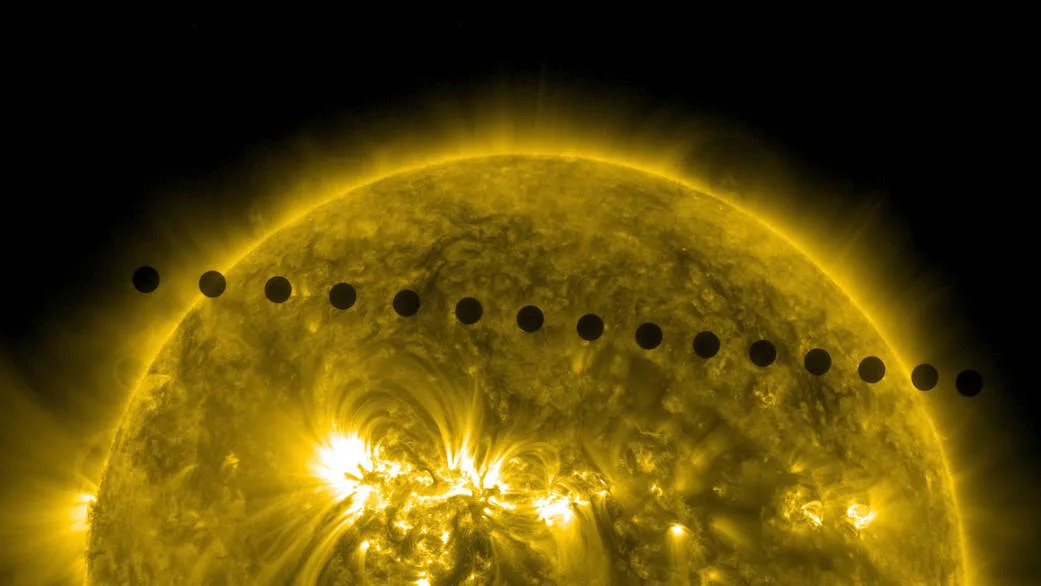
The transit of Venus in 2012 was a truly once-in-a-lifetime celestial event for many, as it was the last such occurrence for over a century, with the next not expected until 2117. It offered a rare opportunity to witness a planet pass directly between the Sun and Earth. (Source: nasa.gov)
You might also like:
👉 Unexplained Mysteries of Science: Cosmos, Quantum & Beyond