JWST Reveals Universe's Dawn Was Faster Than Predicted
JWST data reveals the universe's first stars and galaxies ignited much faster than models predicted, challenging the slow awakening after the Cosmic Dark Ages.
The universe’s story doesn’t quite add up. We thought we knew when the first stars and galaxies lit the dark cosmos. New telescopes peered deeper, further back. What they found is mind-bending. The universe started much faster than our models predicted.
Before JWST, I pictured cosmic dawn as a slow awakening. The Big Bang birthed the universe, then plunged it into the Cosmic Dark Ages. This era lasted hundreds of millions of years. Hot, dense plasma filled the universe. It cooled. Electrons combined with protons, forming neutral hydrogen and helium atoms.
This neutral gas made the universe opaque. No stars or galaxies existed. It was a vast, cold expanse of neutral gas. Scientists call this “Epoch of Reionization.” That’s what we’re trying to understand.
Telescopes are time machines. Light travels at a finite speed. Looking at distant objects means seeing light from billions of years ago. We see the universe as it was. This helps us study cosmic dawn’s “WHERE” and “WHEN.” Hubble and JWST astronomers are the “WHO” in this cosmic detective story.
Hubble’s early hints of a hasty dawn
For decades, Hubble pushed our vision’s limits. It gave us our first real glimpses into the early universe. In the mid-2000s, Hubble found faint, distant galaxies. They appeared from when the universe was less than a billion years old. Its deep surveys, like the Hubble Ultra Deep Field, revealed thousands of galaxies.
By 2016, Hubble, through the Frontier Fields program, showed galaxies at redshifts up to z~11. Their light traveled over 13 billion years to reach us. These tiny, forming galaxies appeared surprisingly numerous. Dr. Richard Ellis at UCL led this. It suggested star formation was more efficient than first thought.
Hubble’s infrared capabilities were limited. It barely detected redshifted light from distant objects. We saw only the brightest tips of the iceberg. Yet, the quantity of these early objects hinted at something. The universe seemed to be lighting up faster than models suggested. I was surprised by how many galaxies Hubble found, given its limits.
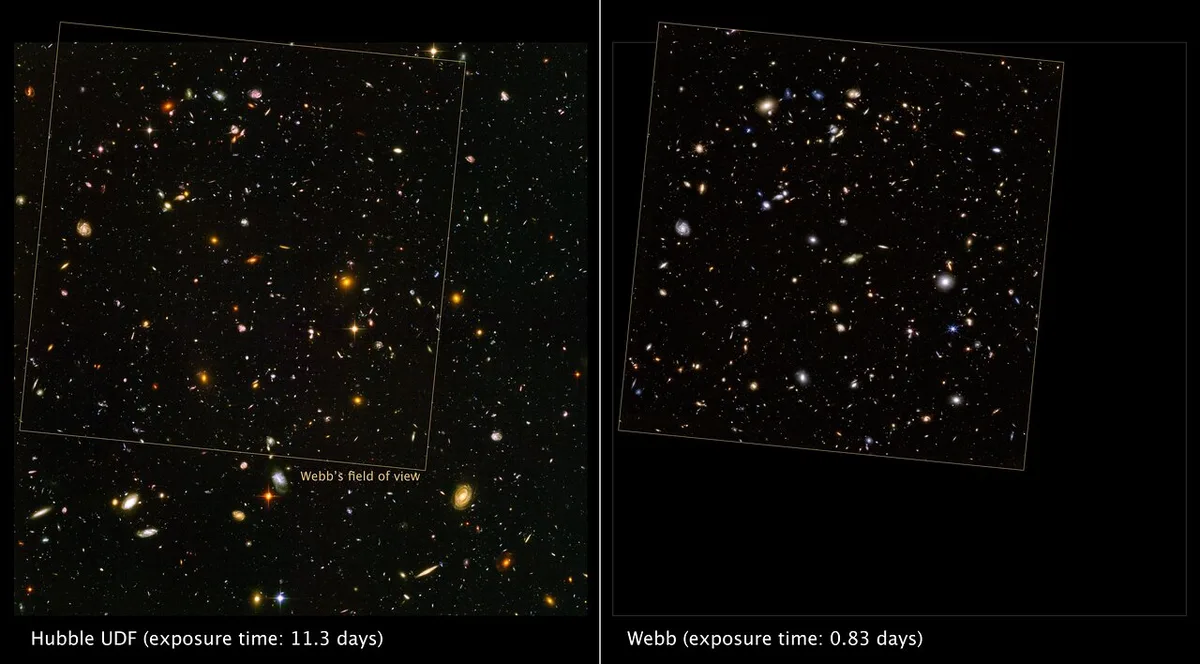
The iconic Hubble Ultra Deep Field image captures thousands of galaxies, some dating back to less than a billion years after the Big Bang, providing crucial insights into the universe's surprisingly rapid early star formation. (Source: esawebb.org)
JWST unveils an unexpectedly bright infancy
Then came the James Webb Space Telescope. Launched December 25, 2021, JWST had unmatched infrared sensitivity. Its 6.5-meter primary mirror is far larger than Hubble’s 2.4 meters. It collected much more light. It also peered deeper into the infrared spectrum. This is vital for observing highly redshifted objects.
JWST’s first full-color images arrived July 2022. They immediately reshaped our understanding. Within months, surveys like CEERS (Cosmic Evolution Early Release Science) and JADES (JWST Advanced Deep Extragalactic Survey) made incredible discoveries. Researchers found galaxies at redshifts z > 10, some even beyond z = 13. GLASS-z13 and JADES-GS-z13-0, for instance, were among the earliest confirmed. Their light left them when the universe was only about 330 million years old.
The real shock wasn’t just finding these galaxies. It was their size and brightness. Dr. Emma Chapman from Nottingham expressed collective surprise. These early galaxies were far brighter and more massive than standard models predicted. Some had stellar masses equal to billions of suns. This suggests they formed stars very rapidly.
My “aha!” moment came seeing these galaxy images. Models predicted slow, gradual growth. But these galaxies were like fully formed toddlers, not newborns. It felt like watching a speeded-up film. The universe manufactured stars and galaxies at an astonishing pace. This challenged the Lambda-CDM model. It suggested a much faster process.
The reionization riddle: where did all the ionizing light go?
JWST showed us a universe teeming with early bright galaxies. But another puzzle piece challenges us. Reionization happened when the universe changed from mostly neutral to mostly ionized hydrogen. Ultraviolet light from the first stars and quasars drove this. Studying it helps us understand the total output of ionizing photons.
Astronomers use radio telescopes like the Low-Frequency Array (LOFAR) in Europe and the Hydrogen Epoch of Reionization Array (HERA) in South Africa. These instruments search for the faint 21-cm signal from neutral hydrogen. This signal directly probes the Dark Ages. Their observations suggest reionization largely finished around redshift z6 to z7. This means it completed when the universe was about 800-900 million years old.
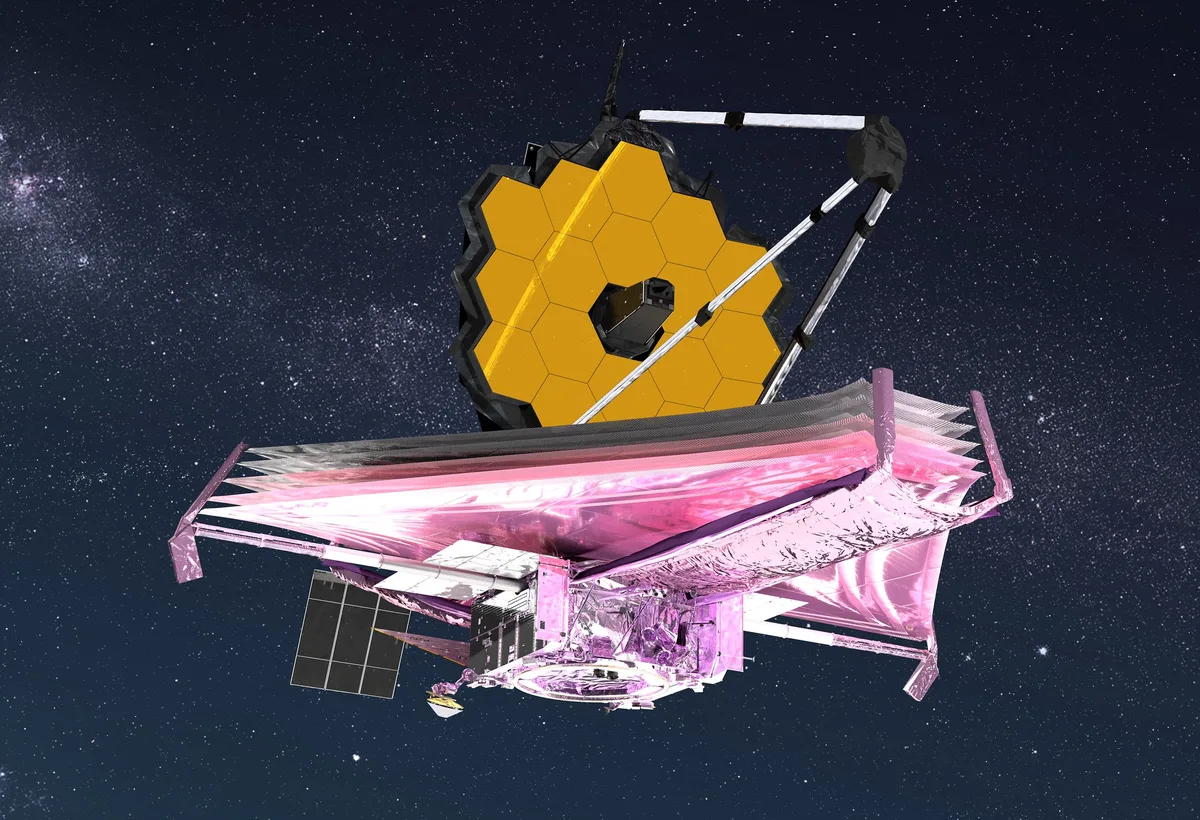
The James Webb Space Telescope, launched in December 2021, is seen fully deployed in space. Its 6.5-meter primary mirror, significantly larger than Hubble's, enables its unmatched infrared sensitivity to observe highly redshifted objects and the universe's earliest galaxies. (Source: space.com)
Here’s the tension. JWST shows many massive, bright galaxies at z > 10. So why did reionization take so long? These early galaxies should have produced a flood of ionizing photons. Dr. Anastasia Fialkov, a Cambridge cosmologist, points out this discrepancy. JWST’s many bright sources imply faster reionization. But LOFAR’s 21-cm observations suggest a longer process.
Maybe early galaxies formed stars very well. But perhaps their ionizing photons escaped into space less effectively. Another idea: the first stars, Population III stars, played a bigger role. These hypothetical stars were massive, metal-free, and short-lived. They produced immense ionizing radiation. They are too faint for JWST to see. The “reionization riddle” remains a big research area. It makes us rethink early galaxy formation and how it affected the gas between them.
FAQ
What is the cosmic dawn? Cosmic Dawn is when the first stars and galaxies ignited. This ended the Universe’s “Dark Ages.” Their light then ionized the neutral hydrogen gas filling space.
How do telescopes see so far back in time? Telescopes act as time machines because light travels at a finite speed. When astronomers observe distant objects, they capture light that left billions of years ago. This shows us the universe in its infancy.
What’s the main surprise from JWST’s discoveries? JWST found many massive, bright galaxies at very early times (z > 10). This shows star formation and galaxy growth happened much faster and earlier. Previous models didn’t predict this.
What were the “dark ages” of the universe? The Dark Ages came after the Big Bang. They lasted hundreds of millions of years. The universe filled with neutral hydrogen and helium gas then. No stars or galaxies existed yet to produce light.
The future of first light
JWST’s discoveries opened a new chapter in cosmology. They’ve forced astronomers to rethink galaxy formation and evolution. We’re grappling with how fast the universe assembled its first structures. This challenges our understanding of dark matter halos and star formation efficiency. It suggests our early universe models might need big adjustments.
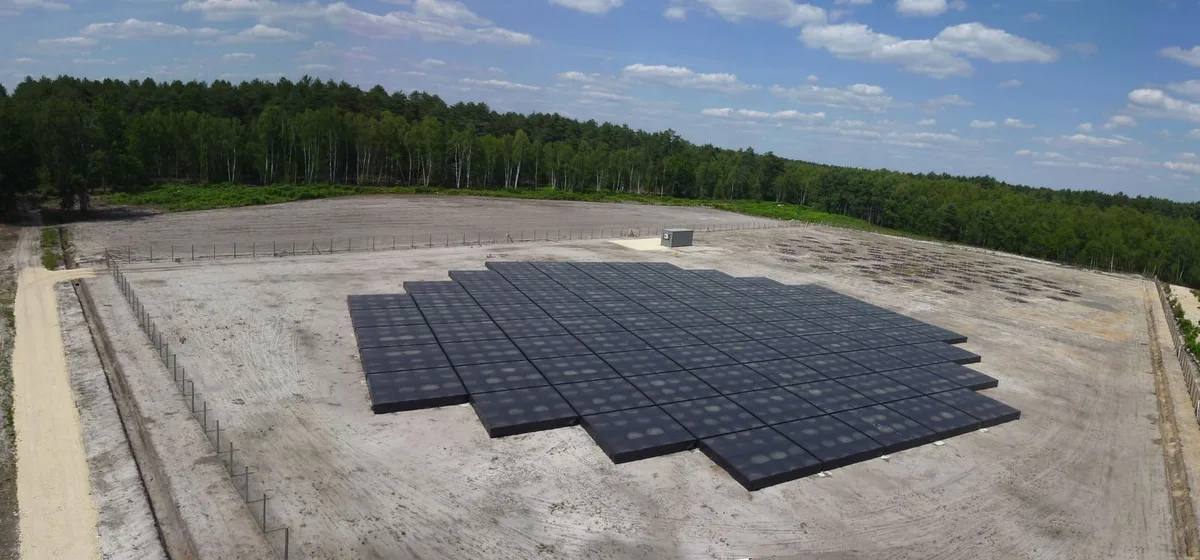
The LOFAR (Low-Frequency Array) is a vast network of radio telescopes across Europe, designed to detect faint radio signals from the early universe. Its 21-cm observations of neutral hydrogen provide crucial data on the reionization epoch, creating a key tension with JWST's findings on early galaxy formation. (Source: observatoiredeparis.psl.eu)
Future JWST observations will push these boundaries further. Scientists will hunt for even earlier galaxies. They’ll also look for direct evidence of Population III stars. Next-gen radio telescopes, like the Square Kilometre Array (SKA), will measure the 21-cm signal more precisely. This will help resolve the reionization riddle. The universe’s infancy is far more dynamic and complex than we imagined. This isn’t just a tweak to our models. It’s a fundamental shift in how we see cosmic history, forcing us to rewrite the early chapters of the universe.
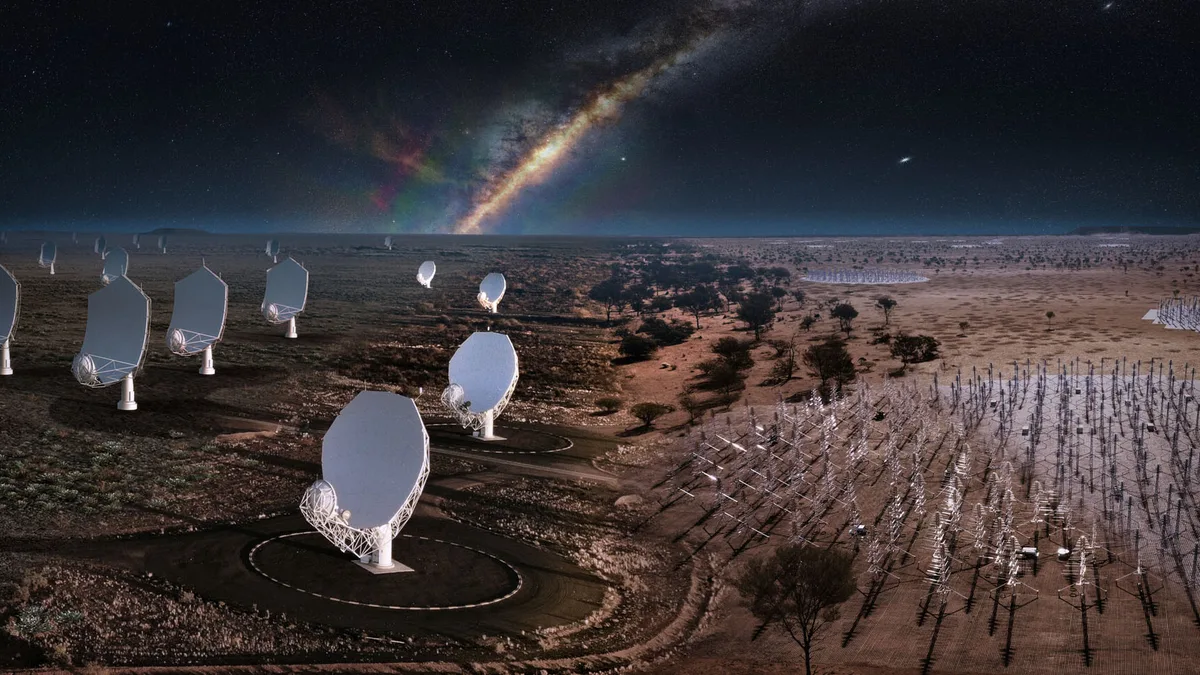
The Square Kilometre Array (SKA) is an ambitious international project building the world's largest radio telescope, with sites in Australia and South Africa. Once completed, its vast network of dishes and antennas will explore the universe's earliest epochs, including the 'cosmic dawn' and the reionization period. (Source: space.com)
You might also like:
👉 Unexplained Mysteries of Science: Cosmos, Quantum & Beyond