
Why Math's 'Solo Genius' Myth Hides Centuries of Work
Many celebrated math ideas have roots in earlier, less known insights, debunking the myth of solo genius and revealing a global human effort.
Mathematics isn’t just numbers; it’s the engine of our modern world. We often celebrate big “breakthroughs” as moments of solo genius. But that popular story misses much of the truth. It simplifies a long, complex journey of discovery.
This article pulls back the curtain on these famous moments. We’ll see how many celebrated ideas have roots in earlier, less known insights. This different view helps us truly appreciate mathematics. It shows math as a global, human effort.
The myth of solo genius: Pythagoras and zero
The Pythagorean Theorem is a geometry staple. Most of us learn that the Greek mathematician Pythagoras discovered it. It states that in a right-angled triangle, a² + b² = c². The Greeks certainly gave us its formal proof and generalization. Those were big contributions.
But people understood this geometric relationship much earlier. The Babylonian tablet Plimpton 322, from around 1800 BCE, shows this. This clay tablet lists numbers that represent Pythagorean triples. Mathematician Eleanor Robson says it shows a deep grasp of number theory. The Babylonians used these ideas for practical land surveying. Their knowledge came over a thousand years before Pythagoras.
The idea of zero also changed mathematics forever. Many believe ancient India invented and spread it. Indian mathematicians formalized zero as a number and placeholder around the 7th century CE. The Bakhshali manuscript, an Indian text from roughly 3rd to 4th century CE, uses a dot for zero.
However, another civilization independently developed zero. The Maya civilization in Mesoamerica used a shell symbol for zero. It appeared in their calendar system as early as 36 BCE. Professor Michael Coe, a Maya expert, notes its vital role. It allowed for complex positional notation. This predates the earliest Indian zero inscriptions by centuries. The Mayan system helped with astronomical calculations.
Calculus: a slow burn, not a sudden spark
Calculus is a revolutionary mathematical tool. It helps us understand change and motion. Isaac Newton and Gottfried Leibniz get credit for independently inventing it in the late 17th century. Their formal systems of differential and integral calculus were monumental. They built the foundation for much of modern physics and engineering.
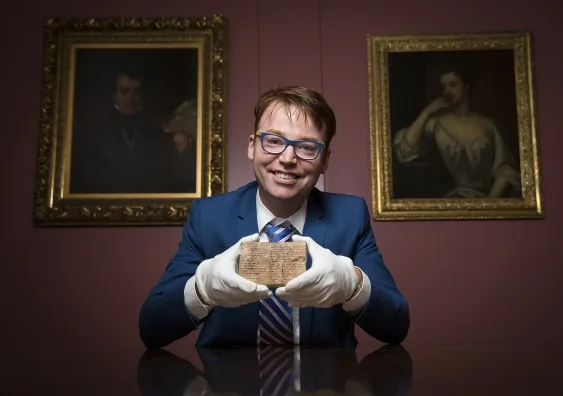
The ancient Babylonian clay tablet known as Plimpton 322, dating to approximately 1800 BCE, is a remarkable artifact listing Pythagorean triples. It provides compelling evidence of sophisticated mathematical knowledge in Mesopotamia over a thousand years before Pythagoras, challenging the myth of solo genius in mathematical discovery. (Source: unsw.edu.au)
Yet, calculus’s core ideas have much older roots. Archimedes of Syracuse, around 250 BCE, used methods like integral calculus. He developed the “method of exhaustion.” This let him calculate areas and volumes of complex shapes. Historian of mathematics Sir Thomas Heath documented Archimedes’ careful approach. He approximated areas by summing infinitely many tiny parts.
Centuries later, Islamic scholars also made big strides. Ibn al-Haytham, an 11th-century polymath, developed a formula for summing integer powers. This is a key step in integration. His work on paraboloid volumes also used methods like integral calculus. Mathematician Roshdi Rashed details al-Haytham’s work in Arabic mathematical history. These were clear precursors to Newton and Leibniz’s formal systems.
Geometry: more than Euclid’s straight lines
Euclid’s Elements, written around 300 BCE, laid out axiomatic geometry. Its strict logic and organized presentation ruled mathematical thought for over 2000 years. It presented geometry as absolute truth. This work remains a classic textbook. Its impact on scientific thinking is undeniable.
But Euclidean geometry’s very success delayed other possibilities. Its assumptions about parallel lines went unchallenged for centuries. Mathematicians struggled to prove Euclid’s Fifth Postulate. This postulate says that through a point not on a given line, only one parallel line can be drawn. This struggle eventually led to a powerful discovery.
The 19th century saw non-Euclidean geometries develop independently. Carl Friedrich Gauss explored these ideas privately. János Bolyai and Nikolai Lobachevsky published their findings around the 1830s. They showed that consistent geometries exist where Euclid’s Fifth Postulate doesn’t hold. Bernhard Riemann, in his 1854 thesis, generalized geometry even further. He introduced curved spaces. These breakthroughs shattered the idea of absolute space. They paved the way for Einstein’s theory of relativity.
Cracks in the foundation: set theory and Gödel
Georg Cantor’s Set Theory, from the late 19th century, changed mathematics. It created a framework for understanding infinity. It let mathematicians compare the sizes of infinite sets. This work seemed to offer a universal language for all mathematics. It opened up entirely new research areas.
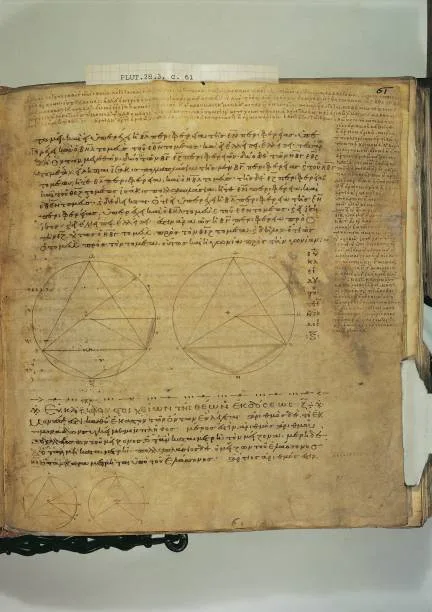
Euclid's Elements, written around 300 BCE, laid the foundation for axiomatic geometry and served as the primary textbook for mathematical thought for over two millennia. Its rigorous logical structure profoundly influenced scientific thinking. (Source: gettyimages.com)
This foundational breakthrough, however, quickly revealed deep paradoxes. Bertrand Russell found his famous paradox in 1901. It showed that “the set of all sets that do not contain themselves” creates a contradiction. This shook the mathematical world. It proved that Cantor’s early set theory was inconsistent.
The crisis spurred intense efforts to rebuild mathematics on surer footing. David Hilbert’s program aimed to formalize all mathematics axiomatically. He wanted to prove its consistency. Then, Kurt Gödel delivered his Incompleteness Theorems in 1931. These theorems showed that any powerful axiomatic system, if consistent, cannot prove all its true statements. It also cannot prove its own consistency. Gödel’s work was a profound logical achievement. It revealed inherent limits. Even the most rigorous mathematical systems have unprovable truths.
Algorithms: ancient roots, modern power
The algorithm is central to modern computing. Alan Turing’s work in the 1930s is foundational. His “Turing machine” concept modeled computation theoretically. It formalized what it means for a problem to be computable. This was a vital step toward modern computers.
But algorithms, as systematic procedures, predate Turing by thousands of years. Euclid’s algorithm, found in his Elements around 300 BCE, is a prime example. This method efficiently calculates the greatest common divisor of two numbers. It’s still used today. Computer science pioneer Donald Knuth often points out its elegance and age.
Centuries later, Muhammad ibn Musa al-Khwarizmi, a 9th-century Persian mathematician, made big contributions. His book, The Compendious Book on Calculation by Completion and Balancing, brought algebra to the Western world. The term “algorithm” itself comes from his name. Al-Khwarizmi detailed step-by-step procedures for solving linear and quadratic equations. His work systematized arithmetic and algebraic computation. This gave people practical ways to solve problems. Turing’s breakthrough was to formalize the universal algorithm. He defined computation’s theoretical limits. He didn’t invent the first algorithmic procedure.
The endless quest: rethinking discovery
Mathematical breakthroughs rarely come from a single genius. They grow from a complex web of ideas. These ideas cross cultures and centuries. Seeing this long story helps us understand math better. It shows math as a truly global human project.
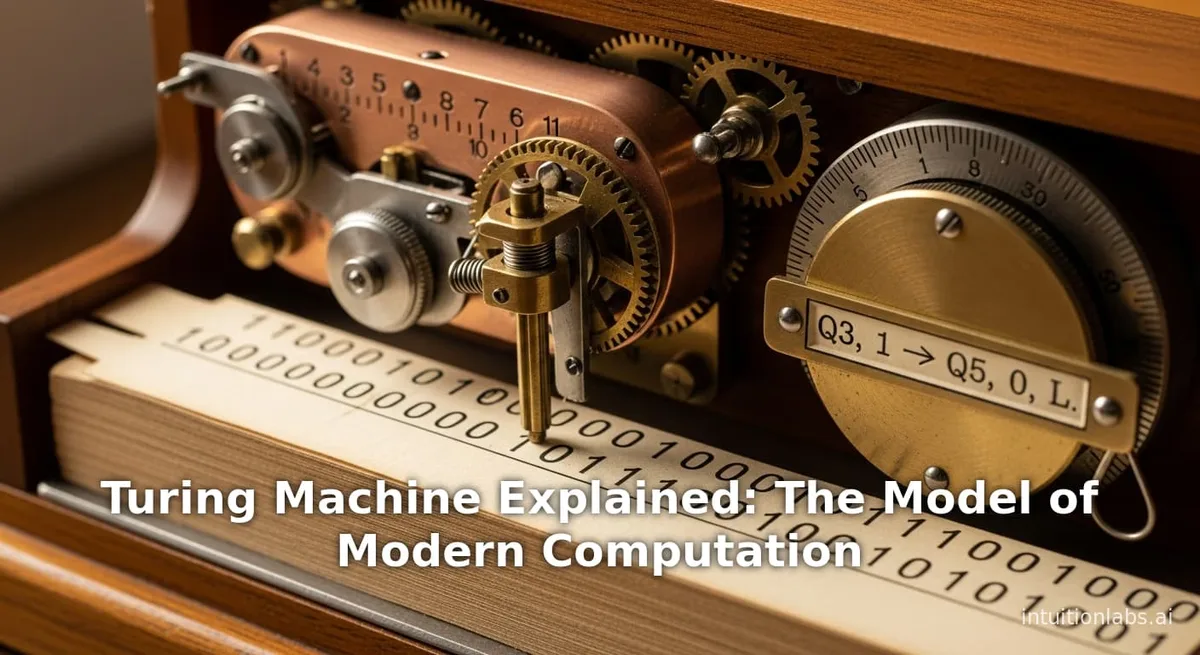
Alan Turing's theoretical 'Turing machine' concept, developed in the 1930s, formalized the idea of an algorithm and what it means for a problem to be computable. This foundational model was a vital step towards the development of modern computers. (Source: intuitionlabs.ai)
We must acknowledge the formalization and rigorous proof from figures like Pythagoras, Newton, and Euclid. These contributions were undeniably transformative. But many core concepts had earlier, less famous, beginnings. These early ideas often came from practical needs or pure curiosity. True progress often means refining old ideas. It also means connecting different fields.
So, the real breakthrough isn’t always the first spark of an idea. It’s the persistent intellectual work. This work involves formalizing, generalizing, and sharing knowledge. It lets future generations build on what came before. This collaborative, continuous nature of discovery is the lasting truth of mathematical progress. It’s what keeps math alive and growing.
FAQ
Q: Why do mainstream accounts often simplify mathematical history? A: Simplified stories are easier to teach and remember. They often focus on individuals who provided clear formalizations or proofs. This overlooks earlier, less systematic contributions.
Q: Does acknowledging precursors diminish the achievements of famous mathematicians? A: Not at all. It provides a richer, more accurate picture of intellectual progress. It highlights the genius needed for formalization and generalization, even if core ideas existed previously.
Q: How does this re-evaluation change our view of mathematical discovery? A: It shifts our perspective from isolated “Eureka!” moments to a continuous, interconnected process. It emphasizes the global and collaborative nature of mathematical development across civilizations.
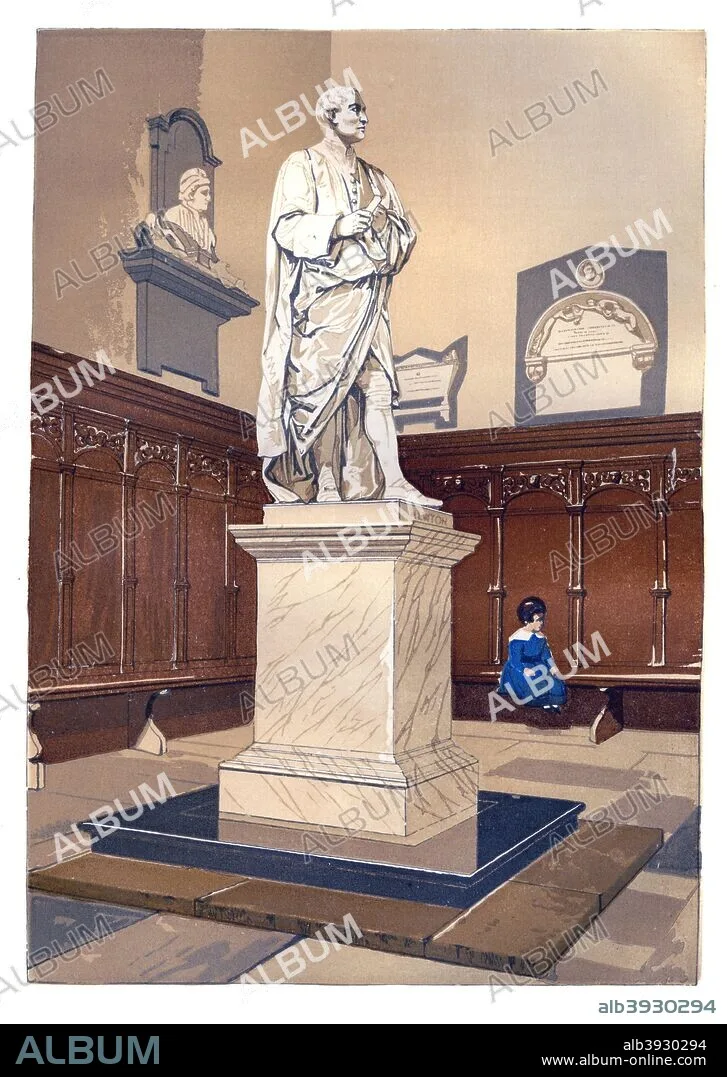
Isaac Newton, one of the figures acknowledged for formalizing and rigorously proving mathematical concepts, developed calculus, a fundamental tool for understanding change and motion. His work exemplifies the persistent intellectual effort that refines old ideas and connects different fields, driving mathematical progress. (Source: album-online.com)
You might also like:
👉 Unearthing History: Famous Archaeological Discoveries & Their Impact
👉 Unexplained Mysteries of Science: Cosmos, Quantum & Beyond