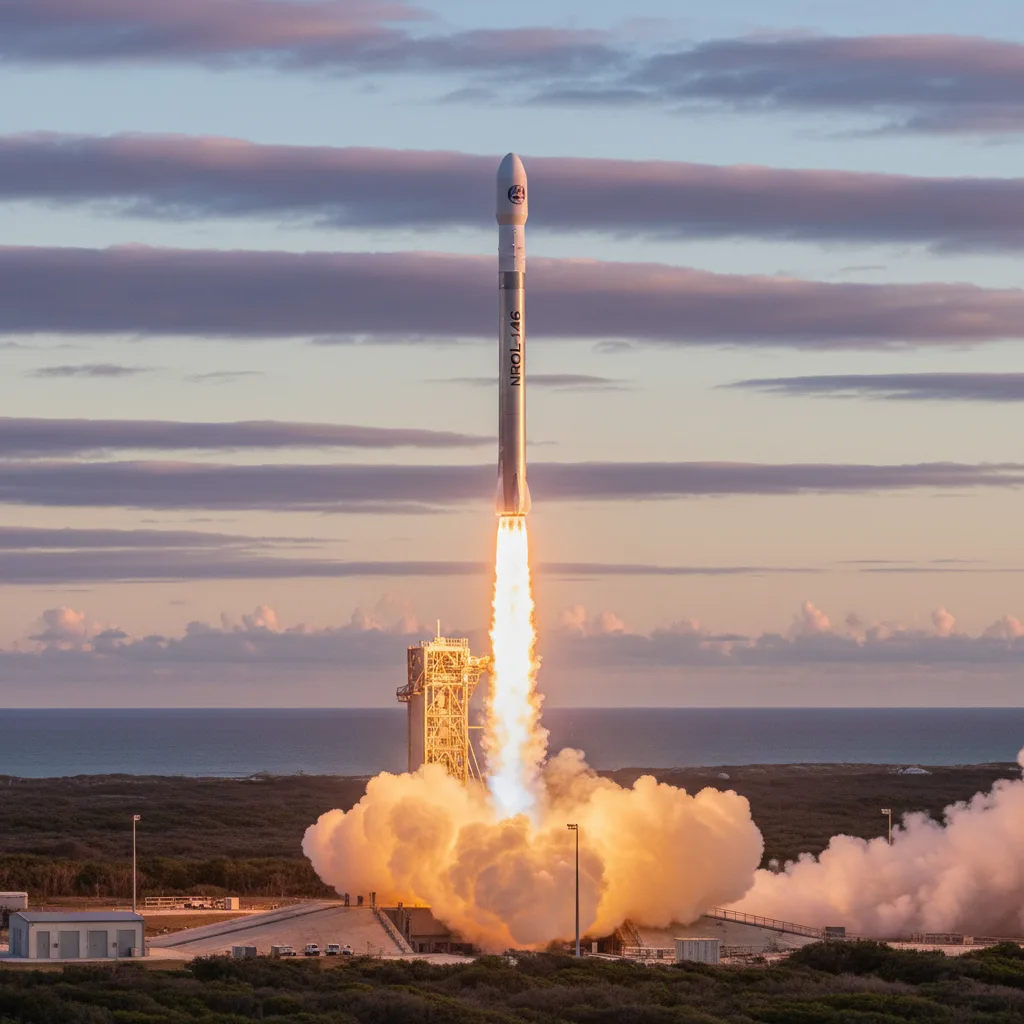
May 9, 2024: SpaceX Launches Next-Gen US Spy Satellites
SpaceX's Falcon 9 rocket launched the classified NROL-146 mission on May 9, 2024, deploying next-gen US spy satellites.
SpaceX and the Invisible Network Above Us
Spy satellites have changed. The image of a single, giant eye in the sky is outdated. Today, an invisible network of smaller, smarter spacecraft watches us. These new systems are tougher and cover more ground. Commercial space companies, especially SpaceX, now launch these important national security tools.
New eyes in the sky
On May 9, 2024, a SpaceX Falcon 9 rocket lifted off from Florida. It carried the NROL-146 mission, a classified payload for the U.S. National Reconnaissance Office (NRO). The NRO builds, launches, and runs America’s intelligence satellites.
The NRO is building a new space system. It uses many smaller satellites flying in Low Earth Orbit (LEO). LEO means altitudes between 100 and 1,200 miles above Earth.
Older, larger satellites often flew in much higher orbits, like geosynchronous orbit (GEO). GEO satellites stay over one spot. These satellites are fewer in number and make an easier target for enemies. The NRO is now shifting to LEO.
A “mega-constellation” of LEO satellites provides a new approach. Hundreds, even thousands, of smaller satellites can watch the globe. Losing one or two won’t cripple the system. This setup gives continuous, global coverage.
The NRO’s big change
The NRO has a long history of running the nation’s space intelligence. It started in 1961 and remained secret for decades. Its job is to provide intelligence data to policymakers, the military, and other intelligence groups.
NRO Director Chris Scolese said in a 2023 press conference the agency is quickly deploying “a new proliferated architecture.” This means spreading intelligence gathering across many satellites. This makes the system tougher and faster to react.
The NROL-87 mission in February 2022 was a big step. It was the first NRO mission to use a SpaceX Falcon 9 rocket. This launch marked a new era. The NRO would now rely on commercial companies for important national security payloads.
The NRO’s new LEO satellites offer better capabilities than older ones. They collect data faster and more often. They also give clearer images and more precise signal intelligence.
SpaceX’s part: fast, cheap, and easy access
SpaceX is a major player in launching these important U.S. government payloads. The company offers lower costs and frequent launch opportunities. This is mostly thanks to its reusable Falcon 9 rockets.
A Falcon 9 first stage booster lands vertically after launch. It can then be refurbished for future missions. This reusability reduces launch costs compared to traditional, expendable rockets. It also allows for many more launches.
The NRO signed a big contract with SpaceX in 2020. It was worth $297 million for three missions. This agreement showed the NRO’s confidence in SpaceX’s reliability. It also emphasized the government’s push to use more launch providers.
The U.S. Space Force gave SpaceX 77% of its National Security Space Launch (NSSL) contracts in 2023. SpaceNews reported this. This shows SpaceX’s market lead. It also shows the government’s urgent need to get to space fast.
What these satellites actually do
These next-generation spy satellites do several important intelligence jobs. They collect images, intercept communications, and watch enemy activities. They give a continuous stream of data to intelligence analysts.
One main job is imagery intelligence (IMINT). These satellites take high-resolution photos and videos of specific spots. This helps intelligence agencies track troop movements. They can also assess damage or watch construction sites. The NROL-146 mission probably helps with this.
Another key role is signals intelligence (SIGINT). These satellites intercept electronic signals, such as radio communications or radar emissions. This helps uncover enemy plans, capabilities, and intentions. They can also pinpoint where specific emitters are.
This network functions like thousands of tiny, advanced binoculars and microphones in orbit. They can zoom in on specific areas. Or they can listen for faint signals across vast distances. This spread-out network means fewer blind spots.
These new satellites are also built for greater resilience. If an enemy tries to target or disable one satellite, the others can pick up the slack. This “strength in numbers” approach keeps intelligence flowing. NRO officials stressed this point in a 2023 statement to the House Armed Services Committee.
A new age for space intelligence
The collaboration between the NRO and SpaceX marks a big change for national security. It represents a move to faster, cheaper, and tougher space systems. The U.S. is adapting to a fast-changing world.
This new approach lets the NRO deploy capabilities faster than ever. It also makes space intelligence less open to attack. This is important now that space itself is a contested area.
These LEO constellations will keep growing. We’ll see more frequent launches of classified payloads from commercial providers. This trend will improve the U.S.’s global awareness and intelligence lead.
Other nations, like China and Russia, are also building their own advanced space capabilities. This increased activity makes tough, dependable intelligence systems even more important. Events in space will shape the future of global security.
FAQ
What is the National Reconnaissance Office (NRO)? The NRO is a U.S. government agency. It builds, launches, and runs the nation’s intelligence satellites. These satellites give important data for national security.
Why does the NRO use SpaceX for launches? SpaceX offers cheap and frequent launch services. Its reusable Falcon 9 rockets cut expenses. They also allow for fast deployment of satellites. This helps the NRO quickly build its new constellations.
What are “next-generation spy satellites”? These are smaller, more numerous satellites in Low Earth Orbit (LEO). They work together as a network. This gives faster data collection, wider coverage, and more resilience than older, larger satellites.
How is this different from older intelligence systems? Older systems used fewer, larger satellites in higher orbits. The new approach uses many smaller satellites in LEO. This makes the whole system harder to disable. It also provides more continuous global surveillance.
You might also like:
👉 The $546 Billion Space Race: Private Money, Global Rivalries
👉 Shahed 136 Drone: Cost-Effective Weapon Reshaping Modern Warfare