
WHO 2019: 1 in 8 Global Mental Disorder. Is it a crisis?
Is mental health truly an accelerating crisis? The WHO estimated in 2019 that one in eight people worldwide lived with a mental disorder.
Beyond the panic: Re-evaluating the mental health ‘crisis’
We hear it everywhere: a mental health crisis. Reports show a global surge in mental health challenges. The World Health Organization (WHO) estimated in 2019 that one in eight people worldwide lived with a mental disorder. Public health bodies, media outlets, and advocacy groups now call mental health an accelerating crisis. This view suggests an explosion of illness, demanding urgent, broad action.
This common story, while showing real problems, often simplifies a complicated situation. It risks misdiagnosing the issue and misdirecting resources. Let’s examine the data and history more closely. The picture isn’t a sudden, universal surge in illness. It’s more about changing definitions, more awareness, and turning normal human distress into medical problems.
People are hurting
Actual data confirms widespread mental distress. In 2021, the U.S. Surgeon General, Dr. Vivek Murthy, warned about “Protecting Youth Mental Health.” His report showed concerning trends among young people. It detailed a 40% increase in suicide rates among adolescents between 2007 and 2018. The Centers for Disease Control and Prevention (CDC) also reported stark findings in 2023. In 2021, 57% of U.S. teenage girls felt persistently sad or hopeless. This figure is double the rate from 2011. Anxiety and depression diagnoses have also risen in many Western countries. These statistics represent real pain and a real need for support. This is an undeniable crisis for many individuals.
What counts as ‘mental illness’?
The idea of “mental illness” itself changed a lot over the past half-century. In 1952, the American Psychiatric Association (APA) published the first Diagnostic and Statistical Manual of Mental Disorders (DSM-I). It listed 106 disorders across 130 pages. The current DSM-5-TR, released in 2022, details 300 disorders across 992 pages.
This expansion broadened diagnostic criteria. Conditions once seen as normal human experiences are now often pathologized. For example, Dr. Allen Frances, former chair of the DSM-IV Task Force, publicly criticized the DSM-5. He argued it overmedicalizes normal behavior. He says it risks turning everyday problems into mental disorders. This diagnostic expansion changes how we see prevalence rates.
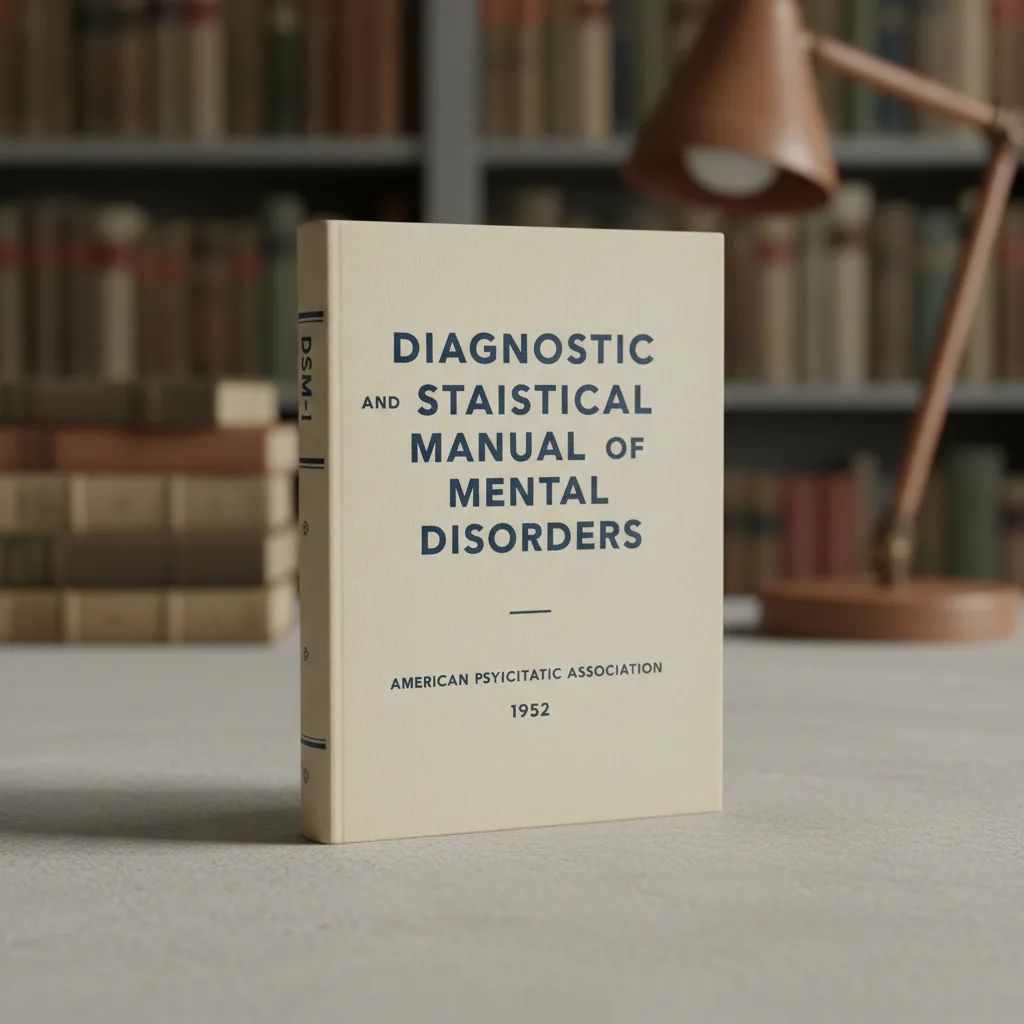
The first edition of the Diagnostic and Statistical Manual of Mental Disorders (DSM-I), published in 1952, listed 106 disorders across 130 pages. This foundational text marked the beginning of standardized psychiatric diagnoses, a system that has expanded significantly over the decades. (AI-generated illustration)
More diagnoses, not necessarily more illness
Mental health awareness campaigns have successfully reduced stigma. Groups like NAMI (National Alliance on Mental Illness) worked hard to encourage open conversations. This success means more people seek help and get a diagnosis. A 2023 survey by the American Psychological Association (APA) found that 91% of U.S. adults believe mental health is important. This shows a big shift in public perception.
However, more diagnoses don’t automatically mean a proportional rise in actual underlying illness. Dr. Thomas Insel, former director of the National Institute of Mental Health (NIMH), noted something in 2017. He said that despite decades of neuroscience research, “suicide, drug overdose, and disability from mental illness continue to rise.” He suggested more diagnoses don’t necessarily lead to better outcomes. This shows a key difference between identifying conditions and treating them effectively.
Social media: Cause or scapegoat?
Many people blame social media for rising mental health issues, especially in youth. Jonathan Haidt’s 2024 book, The Anxious Generation, for example, argues that smartphones and social media are rewiring childhood. He claims a direct link between more screen time and declining mental well-being in adolescents. This idea is popular. However, the scientific evidence for a direct link is less straightforward than it seems. A 2023 review in Nature Human Behaviour examined hundreds of studies on social media and adolescent well-being. It found that while some links exist, the effects are often small and vary greatly across individuals. Professor Candice Odgers, a co-author, emphasized that social media is “not a primary cause of the mental health crisis.” Other factors often play larger, more consistent roles. These include economic inequality, academic pressure, and family stress.
Misery, medicated
The public health response to mental distress often relies heavily on medication. Antidepressant prescriptions have soared in many developed nations. In England, the number of antidepressant items prescribed annually increased from 70.9 million in 2018/19 to 85.6 million in 2022/23. This data comes from NHS Digital. This suggests a widespread reliance on drug solutions.
This medical approach can hide other causes of distress. Many human experiences, like grief, loneliness, or existential angst, are normal parts of life. They aren’t necessarily signs of a clinical disorder. Dr. Peter Breggin, a psychiatrist and critic of psychiatric drug use, has long argued against pathologizing normal emotional responses. He says labeling these experiences as “illness” and treating them with drugs can disempower individuals. It stops them from addressing root causes through social or psychological means.
Beyond the clinic: Real solutions
Addressing mental well-being requires more than just clinical interventions. The true crisis isn’t just an explosion of new mental illnesses. It’s a crisis of meaning, connection, and societal support. Sociologist Robert Putnam’s 2000 book, Bowling Alone, showed a big drop in social capital and civic engagement in the U.S. This trend continues. It leaves many feeling isolated and adrift. Addressing this needs more than clinical diagnoses.
We should focus on community solutions and prevention, not just medical ones. Initiatives that build social cohesion, like local community centers or volunteer programs, strengthen individual resilience. Education systems should also teach strong emotional skills and coping strategies. This approach sees how individual well-being and societal health connect. It’s about creating places where people can thrive, not just treating symptoms as they emerge.
FAQ
What does “diagnostic inflation” mean? Diagnostic inflation means criteria for mental health conditions got broader over time. It can lead to more people receiving diagnoses for behaviors previously considered normal variations.
Is social media entirely blameless for mental health issues? No, social media can contribute to distress for some individuals, particularly regarding comparison or cyberbullying. However, research suggests it’s rarely the primary cause of severe mental illness.
Why is distinguishing between “prevalence” and “diagnosis” important? Prevalence refers to the actual occurrence of a condition in a population. Diagnosis is when a professional identifies a condition. Increased diagnoses can reflect better detection and reduced stigma, not necessarily a higher true prevalence of illness.

Robert Putnam's influential 2000 book, *Bowling Alone: The Collapse and Revival of American Community*, documented a significant decline in social capital and civic engagement in the U.S., a trend often cited as contributing to feelings of isolation and a crisis of connection. (Source: audible.com)
What are some non-medical approaches to mental well-being? Non-medical approaches include building strong social connections, engaging in meaningful activities, improving economic security, and developing emotional coping skills. These focus on root causes and resilience.
You might also like:
👉 The Human Brain: Unraveling Its Mysteries & How It Works
👉 Virtual Reality for Alcohol Misuse Treatment: A Deep Dive
👉 Virtual Reality: Revolutionizing Autism Inclusion & Social Skills