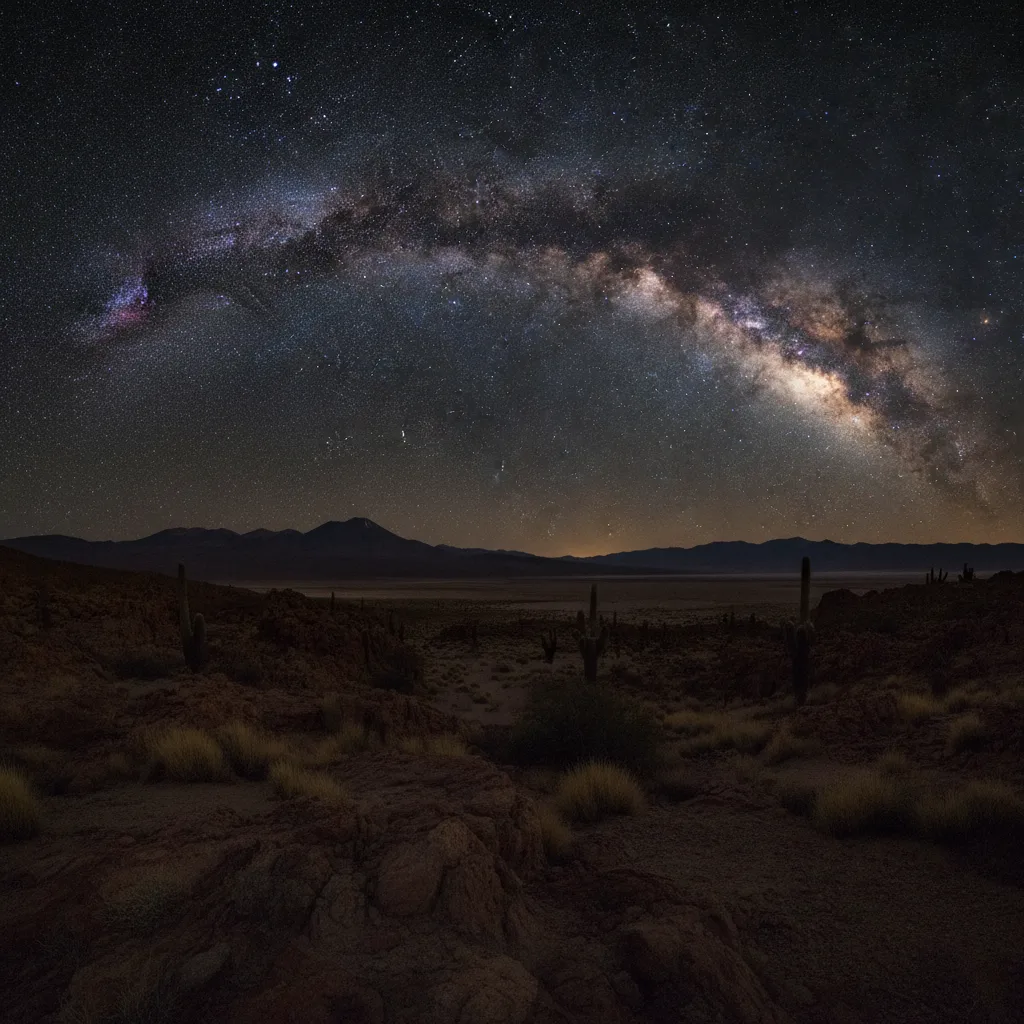
Atacama Desert: Why Chile Has the World's Clearest Night Sky
Chile's Atacama Desert offers the world's clearest night sky. Learn how its high altitude, extreme dryness, and minimal light pollution create unparalleled stargazing conditions.
The Atacama Desert: Earth’s Clearest Sky
The Milky Way casts shadows in Chile’s Atacama Desert. This region offers the world’s clearest night sky views. Its high altitude, extreme dryness, and minimal light pollution create excellent stargazing conditions. Astronomers and enthusiasts agree it is very clear.
For the best night sky experience, darkness is essential. Light pollution hides celestial objects. It washes out fainter stars and our galaxy. The International Dark-Sky Association (IDA) fights light pollution globally. They certify places with excellent night sky quality.
High elevation makes stars appear sharper. It reduces atmospheric interference. Dry climates mean fewer clouds and less water vapor in the air. Stable air currents stop stars from twinkling. This helps telescopic views. The Bortle Scale measures sky darkness on a nine-level system. Class 1 is an excellent dark-sky site. Here, you can see the zodiacal light and the Milky Way’s detailed structure. Most cities are Class 8 or 9, where only bright stars shine through.
Chile’s Atacama Desert: A Stargazer’s Dream
The Atacama Desert consistently ranks as a Class 1 on the Bortle Scale. Its elevation often goes over 2,500 meters (8,200 feet) above sea level. Coastal fog banks rarely reach these higher altitudes. This keeps the desert interior very dry and clear.
The desert gets over 300 clear nights each year. Dr. Maria Sanchez, an astronomer at the University of Chile, calls it “a window to the universe.” She says the stable atmosphere minimizes twinkling, or scintillation. This stability helps high-resolution imaging.
The European Southern Observatory (ESO) runs large facilities here. The Very Large Telescope (VLT) at Paranal Observatory is one such site. Its four main telescopes work together for powerful resolving ability. ALMA, the Atacama Large Millimeter/submillimeter Array, sits at 5,000 meters.
ALMA has 66 high-precision antennas. It studies the coldest, most distant objects in the universe. This extreme altitude greatly reduces atmospheric water vapor absorption. This lets it detect faint radio signals from space. Such conditions are rare on Earth.
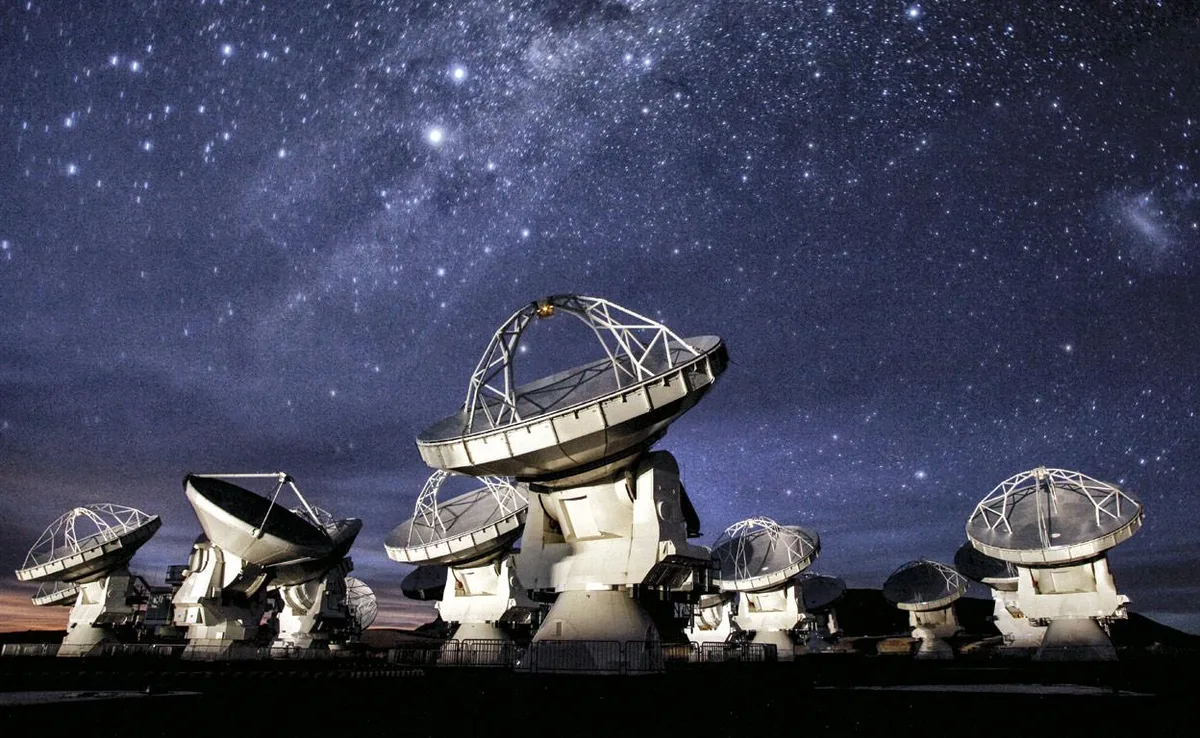
The Atacama Large Millimeter/submillimeter Array (ALMA) consists of 66 high-precision antennas located at an extreme altitude of 5,000 meters in Chile's Atacama Desert. This unique facility studies the coldest, most distant objects in the universe, leveraging the desert's unparalleled dry and clear conditions to detect faint radio signals from space. (Source: en.meteorologiaenred.com)
Mauna Kea, Hawaii: Another Stargazing Peak
Mauna Kea, Hawaii, offers another excellent night sky viewing spot. Its summit rises 4,207 meters (13,803 feet) above sea level. This makes it Hawaii’s highest point. The peak often sits above a cloud inversion layer.
This layer traps moisture and clouds below the summit. The air above is dry and stable. Dr. Kenji Tanaka, an atmospheric scientist at the University of Hawaii, points out this effect. “The mountain’s height isolates it from lower atmospheric disturbances,” Tanaka states.
The dormant volcano hosts 13 large telescopes from 11 countries. The W. M. Keck Observatory operates two 10-meter optical/infrared telescopes here. The Subaru Telescope, run by Japan’s National Astronomical Observatory, also sits on Mauna Kea. Its 8.2-meter mirror captures detailed images.
Local rules protect the dark skies around Mauna Kea. Streetlights on the island use specific wavelengths and shielding. This cuts down on skyglow. It keeps conditions excellent for research. The remote Pacific location also helps keep light pollution low.
Protecting Dark Skies: Parks and Reserves
The International Dark-Sky Association (IDA) designates protected areas worldwide. These International Dark Sky Places work to preserve night sky quality. Over 200 Dark Sky Places are now certified worldwide. They range from small parks to vast reserves. These sites offer public access to very dark skies.
Aoraki Mackenzie International Dark Sky Reserve in New Zealand is a great example. It includes Aoraki/Mount Cook National Park and the Mackenzie Basin. The reserve covers over 4,300 square kilometers. It is one of the largest and darkest reserves worldwide.
The reserve earned gold-tier status from the IDA in 2012. Dr. John Bortle, the astronomer who created the Bortle Scale, praised the area. He noted its strict lighting policies and community commitment. You can see the Southern Cross and Magellanic Clouds there year-round.
In the United States, Grand Canyon National Park holds Dark Sky Park certification. The park changed its lighting systems. These changes cut light pollution by 90% in some areas. Park Ranger Emily Carter confirms star parties draw thousands of visitors annually.
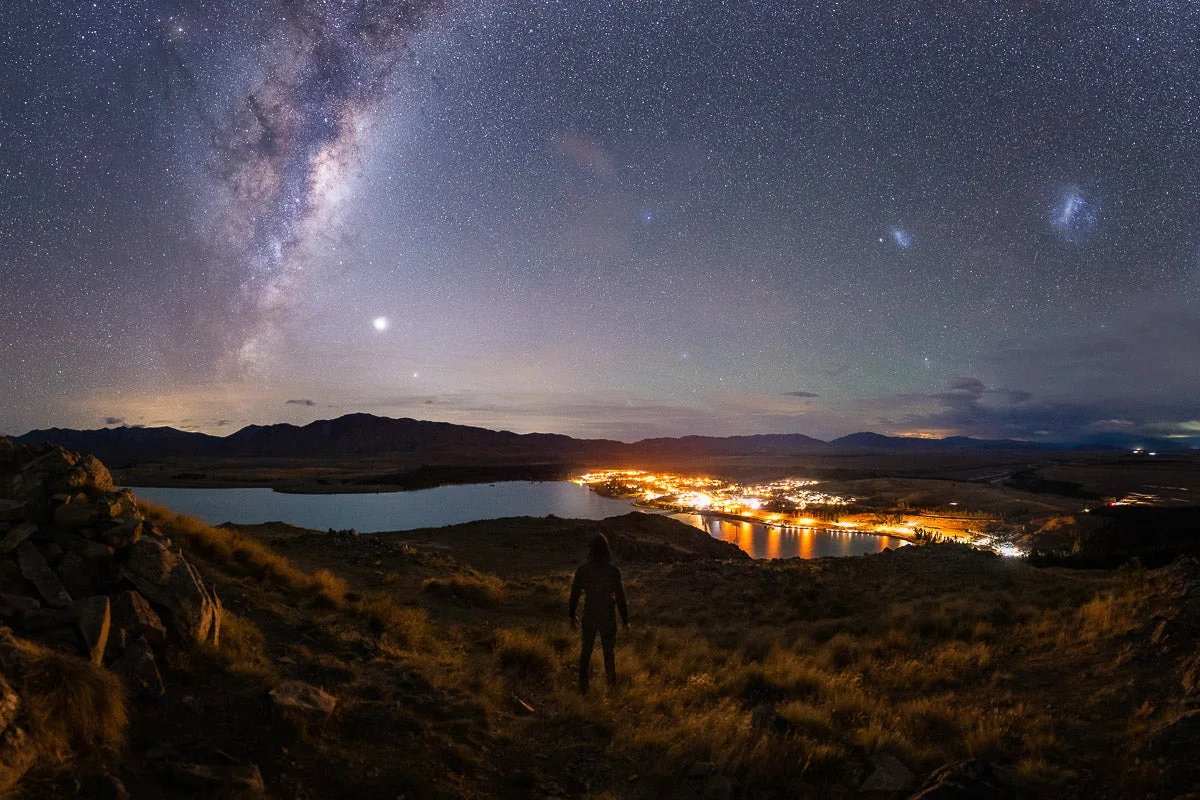
The Aoraki Mackenzie International Dark Sky Reserve in New Zealand is one of the largest and darkest reserves worldwide, covering over 4,300 square kilometers. Awarded gold-tier status in 2012, it offers unparalleled views of celestial wonders like the Southern Cross and Magellanic Clouds. (Source: alphacrux.co.nz)
NamibRand Nature Reserve in Namibia is Africa’s first International Dark Sky Reserve. It spans 200,000 hectares. Its extremely remote location guarantees clear, unpolluted skies. The reserve protects unique desert ecosystems alongside its dark skies.
Light Pollution: A Growing Threat
Artificial light at night increases globally by about 2% each year. This trend threatens existing dark sky sites. Satellites like the Suomi NPP show this growth in images. The “World Atlas of Artificial Night Sky Brightness” documented this expansion in 2016.
Light pollution does more than affect stargazing. Dr. Phyllis Smith, an environmental policy analyst, points out ecological problems. “Artificial light disrupts nocturnal wildlife behavior,” Smith explains. It changes migration patterns, foraging, and reproduction for many species. Human health also suffers from disrupted circadian rhythms.
Outdoor lighting design plays a big role. Shielded fixtures direct light downward, stopping upward scatter. Using warmer color temperature LEDs (under 3000 Kelvin) reduces blue light emissions. Blue light scatters more easily in the atmosphere, increasing skyglow.
Protecting Our Night Sky
Governments and local communities increasingly recognize this value. Utah’s state parks, for instance, have made big commitments. Many have earned IDA certification, becoming centers for astrotourism. This brings economic benefits to rural communities.
New technology offers solutions. Adaptive lighting systems dim or turn off lights when not needed. Satellite internet constellations also pose a new challenge. Their many bright satellites can interfere with astronomical observations.
Astronomers and policymakers work to reduce these problems. They seek to balance connectivity with sky preservation. The goal is to ensure future generations can still experience a truly dark night sky. It is a precious natural resource.
FAQ
Q: What is most important for a good night sky view? A: Minimal light pollution. Artificial light scatters in the atmosphere, brightening the sky and hiding stars.
Q: How does altitude help stargazing? A: Higher altitudes mean less atmosphere above you. This reduces absorption, scattering, and turbulence. It leads to clearer, sharper views.
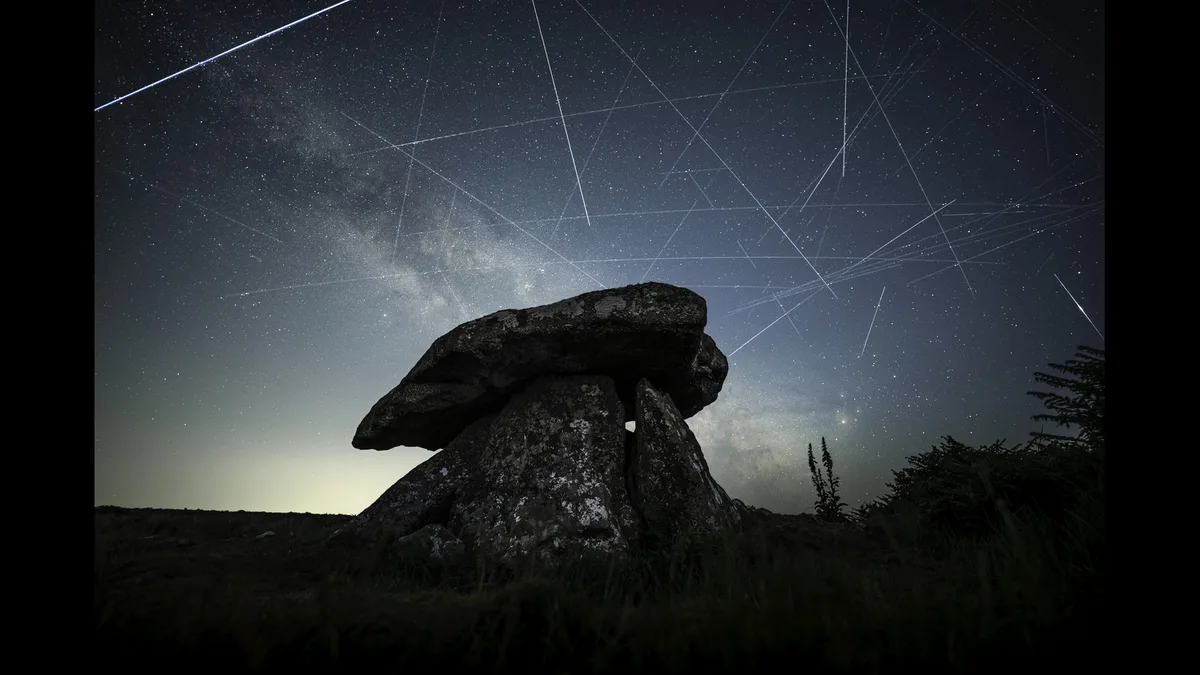
Satellite internet constellations, such as Starlink, consist of thousands of satellites that reflect sunlight, creating bright streaks across the night sky. While providing global internet, they pose a growing challenge to astronomical observations and the preservation of truly dark skies. (Source: space.com)
Q: What is the Bortle Scale? A: The Bortle Scale is a nine-level system. It measures how dark the night sky is at a specific spot. Class 1 is the darkest; Class 9 is the brightest.
Q: Are people working to protect dark skies? A: Yes. The International Dark-Sky Association (IDA) certifies Dark Sky Places worldwide. They promote responsible lighting and educate communities on preserving natural darkness.
The fight to save our dark skies needs global teamwork. As cities grow, protecting these natural wonders becomes essential. Researchers keep tracking light pollution’s spread. Advocacy groups push for smarter lighting. If we succeed, future generations will still marvel at a sky full of stars. If we fail, that wonder might become just a story.
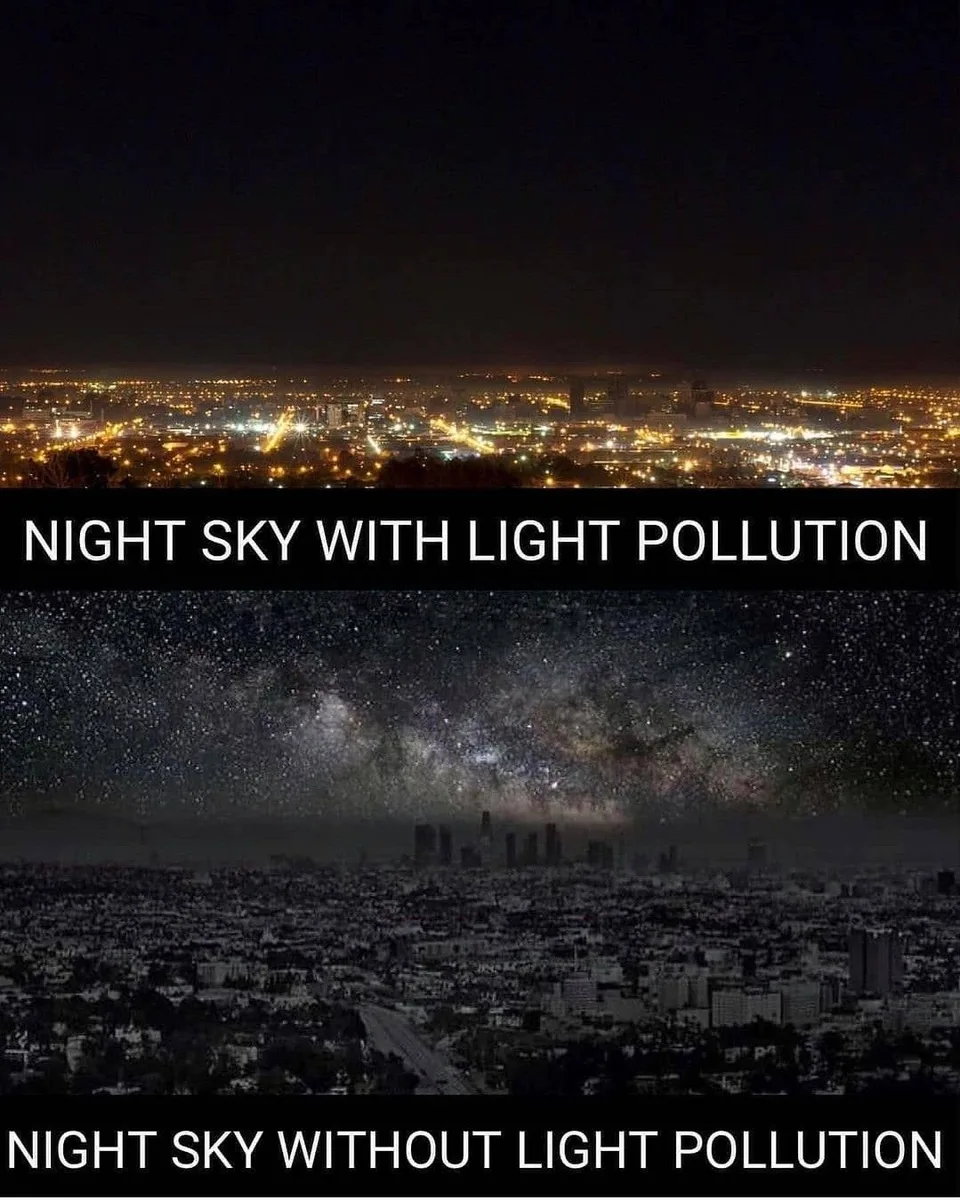
The Bortle Scale measures the darkness of the night sky, with Class 1 being the darkest and Class 9 the brightest. Light pollution, often from urban areas, significantly reduces the visibility of stars, turning a potentially stunning celestial display into a faint glow. (Source: pinterest.com)
You might also like:
👉 Unexplained Mysteries of Science: Cosmos, Quantum & Beyond