Crypto Liquidations: The Hidden Force Behind Bitcoin's Swings
Liquidation isn't just traders losing money; it's a forced selling event that amplifies crypto market dips into full-blown cascades.
Crypto’s secret weapon: understanding liquidations
When crypto markets crash, it feels like chaos. But a hidden mechanism often pulls the strings. Most people follow crypto prices. They see headlines about Bitcoin or Ethereum rising or falling dramatically. What they don’t see is a hidden mechanism amplifying these swings. It’s called liquidation. It turns a market dip into a full-blown cascade.
This isn’t just about traders losing money when prices drop. It’s a forced selling event. This accelerates the downward spiral. It creates a feedback loop that hits the whole market.
Borrowing big: how leverage amplifies crypto
In March 2020, “Crypto Black Thursday” hit. Bitcoin’s price plunged over 50% in 24 hours. This massive drop wasn’t just organic selling. It triggered an avalanche of forced liquidations across the market. These liquidations amplified the crash.
Imagine buying a house with a mortgage. You put down 10%. The bank lends you the other 90%. Your small investment now controls a much larger asset. This is how leverage works in crypto.
Traders use leverage to magnify their positions. They deposit their own crypto, like Bitcoin, as collateral. Then, they borrow more funds from an exchange or lending platform. This lets them trade with more capital than they actually own.
For example, a trader might deposit $1,000 worth of Bitcoin. They could then borrow another $4,000 to buy even more Bitcoin. Now they control $5,000 worth of Bitcoin with their initial $1,000. If Bitcoin’s price goes up by 10%, their $5,000 position gains $500. Without leverage, their original $1,000 would only gain $100.
This strategy amplifies potential gains. But it also dramatically increases potential losses. Centralized exchanges like Binance and Bybit offer leverage up to 100x or even 125x for futures trading. Their platform documentation confirms this. Decentralized finance (DeFi) platforms also offer leveraged lending.
Your initial deposit is your collateral. It secures the loan against your trading position. The platform constantly monitors your collateral’s value against the borrowed amount. This calculation creates your margin ratio. This ratio shows the health of your leveraged position.
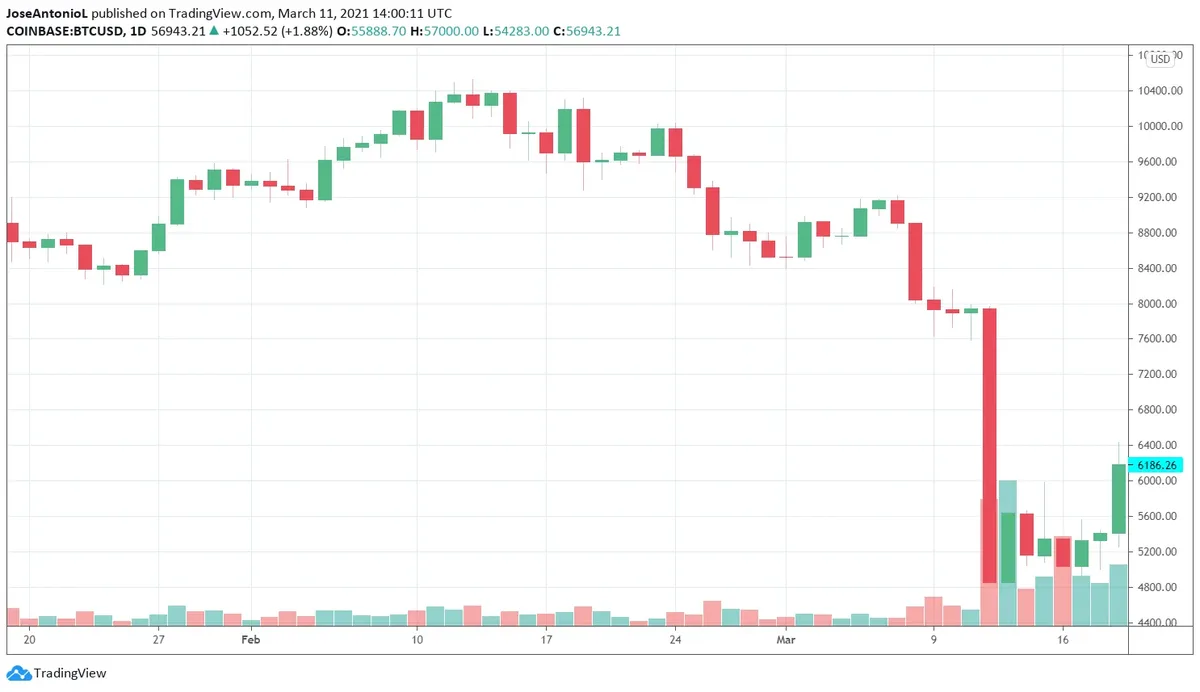
On March 12, 2020, Bitcoin's price plummeted over 50% in a single day, an event dubbed 'Crypto Black Thursday.' This massive drop triggered an avalanche of forced liquidations, amplifying the market crash. (Source: decrypt.co)
When prices crash: the liquidation cascade
On May 19, 2021, over $9 billion in leveraged crypto positions were liquidated in 24 hours. Coinglass data confirmed this historic event. This single day showed how quickly the market reacts to falling prices.
Think of it like a safety mechanism for the lender. If your collateral’s value (your deposited Bitcoin) drops too much, your margin ratio falls. It dips below a specific threshold. This threshold is called the liquidation price.
When your position hits this price, the exchange or lending protocol acts automatically. It sells your collateral without your permission. This forced sale repays the borrowed funds. This is a liquidation. It protects the lender from losing money.
The problem starts when many traders hold leveraged positions. A sudden market downturn can push countless positions to their liquidation prices at once. When these positions liquidate, automated selling adds significant selling pressure. This pushes prices down further.
This downward movement then triggers even more liquidations. It creates a domino effect. This feedback loop is known as a liquidation cascade or a “death spiral.” It turns a moderate price correction into a much more severe market crash.
A Glassnode report in 2022 explained how these cascades contribute to market downturns. It explained how forced sales often worsen rapid price declines. Traders receive a margin call when their collateral gets low. This is a warning to add more funds. If they don’t, the automated liquidation follows.
Specialized bots or entities called liquidators execute these sales. They ensure the protocol’s solvency by quickly selling assets. This process is efficient and automatic.
The ripple effect: liquidations hit everyone
During the Terra-Luna collapse in May 2022, Bitcoin’s price plummeted from over $30,000 to under $20,000 in days. This triggered hundreds of millions in liquidations. CoinDesk reported widely on the market data. The ripple effects hit the entire crypto ecosystem.
Liquidations don’t just affect individual traders who use leverage. They accelerate market downturns. They turn simple price dips into full-blown market crashes. This amplification impacts even those who aren’t using leverage.

The Terra-Luna collapse in May 2022 saw the stablecoin UST de-peg and the LUNA token plummet from over $80 to fractions of a cent, wiping out billions in investor capital and triggering hundreds of millions in liquidations across the broader crypto market. (Source: cryptosavvy.com)
The crypto market is highly interconnected. Large centralized exchanges (CEXs) and decentralized finance (DeFi) protocols share liquidity. A major liquidation event on one platform can send shockwaves across others. This creates systemic risk.
The collapse of Three Arrows Capital (3AC) in mid-2022 showed this contagion clearly. 3AC, a major crypto hedge fund, held massive leveraged positions across many platforms. When these positions faced liquidation, it created widespread financial distress. Major lenders like BlockFi and Celsius faced insolvency from their exposure to 3AC. Bloomberg and the Wall Street Journal reported this.
This interconnectedness means one point of failure, or a large liquidation, can spread distress. It affects many participants. This can lead to broader market instability.
Liquidations aren’t exclusive to bear markets either. They can also occur during rapid price increases. This happens when traders are “shorting” an asset, betting its price will fall. If the price suddenly surges, these leveraged short positions can liquidate. Santiment data often highlights these “short squeezes.”
What’s next for crypto markets?
Regulators worldwide are increasingly examining leveraged crypto products. Agencies like the SEC in the US and the FCA in the UK have expressed concerns. They worry about consumer protection and market stability. Their official statements show this growing attention.
This increased examination is already leading to changes. Some exchanges are reducing the maximum leverage available to traders. For instance, Binance cut maximum leverage for new users to 20x in 2021. This move reduced risk exposure for retail traders. Other platforms are making their liquidation mechanisms more transparent.
There’s a key distinction between CeFi and DeFi liquidations. In CeFi (Centralized Finance), exchanges manage liquidations. They might offer warnings or grace periods. They also have teams to manage risk. In DeFi (Decentralized Finance), liquidations are fully automated. Smart contracts execute them instantly when conditions are met. There’s no human intervention or second chances.
Understanding leverage risks is essential for any participant. Traders must actively monitor their margin ratios. They need to be ready to add more collateral if prices move against them. Using stop-loss orders also helps. These orders automatically close a position at a set price. This limits potential losses and avoids forced liquidations.

Su Zhu and Kyle Davies were the co-founders of Three Arrows Capital (3AC), a prominent crypto hedge fund whose collapse in mid-2022 due to massive leveraged positions triggered widespread contagion across the crypto market, leading to insolvencies for major lenders like BlockFi and Celsius. (Source: businesstimes.com.sg)
As the crypto market matures, it will likely see more sophisticated risk management tools. It will also face stricter regulations on leveraged products. These changes aim to create a more stable, less volatile environment. But crypto’s inherent volatility, combined with leverage, means liquidations aren’t going anywhere. They’ll remain a major market force.
FAQ
-
What’s crypto leverage? Leverage lets traders borrow funds to increase their trading position beyond their initial capital. It magnifies both potential gains and losses.
-
How does liquidation happen? If the value of a trader’s collateral falls below a certain threshold, the platform automatically sells their assets. This repays the borrowed funds to the lender.
-
Why are liquidations bad for the market? They create a cascading effect. Forced selling pushes prices down further, triggering more liquidations. This can amplify market downturns significantly.
-
Can I avoid liquidation? Yes. You can add more collateral to your position. You can also use stop-loss orders to automatically close a position before it reaches its liquidation price.
A margin call is a demand from a cryptocurrency exchange for a trader to deposit additional funds or collateral to maintain their leveraged position. Failure to meet a margin call often results in the automatic liquidation of assets to repay borrowed funds, as explained in the passage. (Source: cryptonews.com)
You might also like:
👉 The Future of DeFi Protocols: Navigating Web3’s Financial Revolution